Cats and Cockroaches: 7 Ways Your Cat Is Keeping Your Home in Order You Never Noticed
Published in Cats & Dogs News
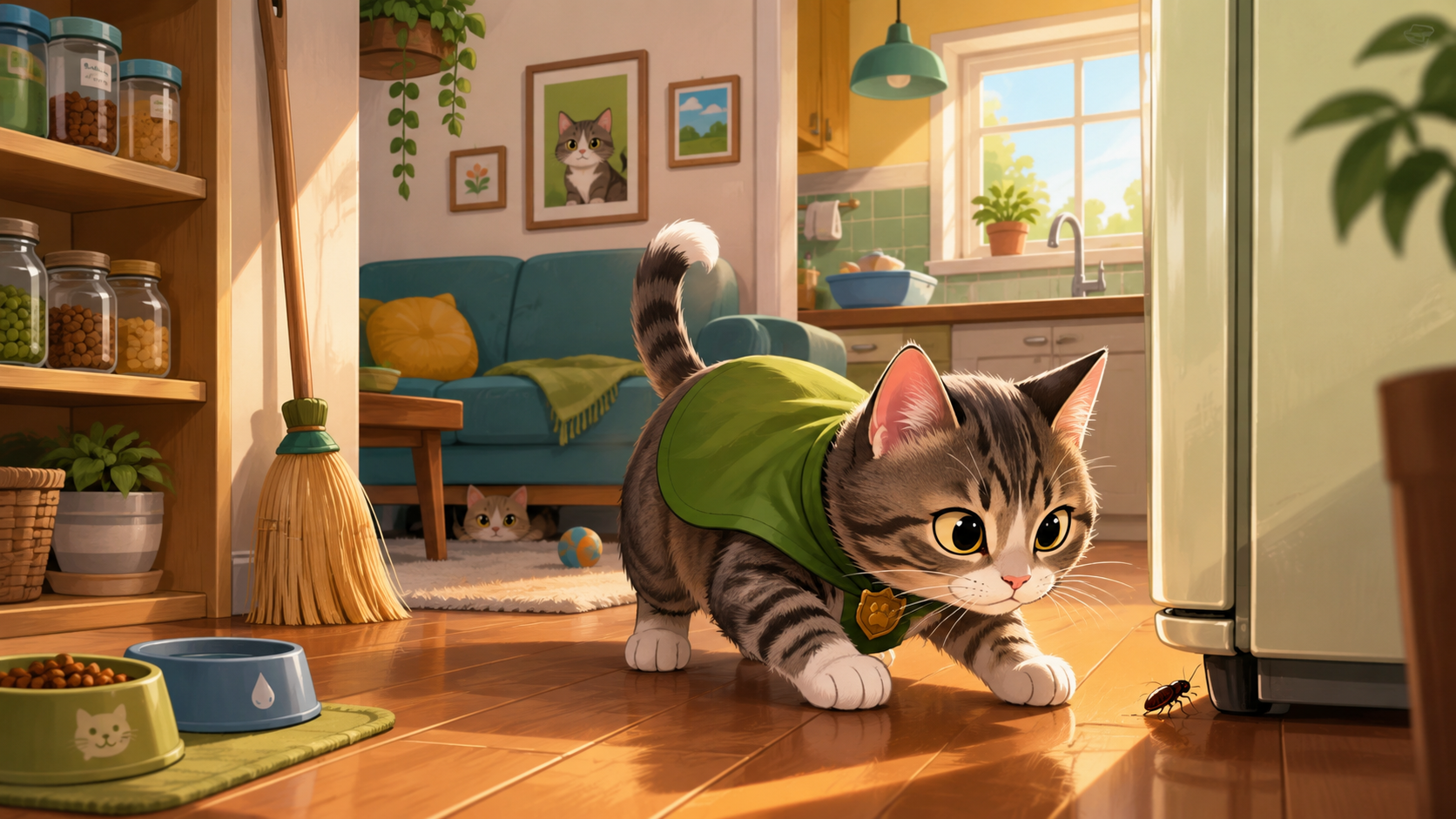
Cats have a reputation for contributing very little to household management.
They sleep on freshly folded laundry, knock pens off desks, sit directly on whatever you are trying to read and occasionally announce at 3 a.m. that a closed door represents an intolerable violation of their civil rights.
Yet your cat may be doing more around the house than you realize.
Domestic cats retain many of the hunting instincts of their wild ancestors, and those instincts do not disappear just because dinner arrives in a ceramic bowl twice a day. Cats notice movement, investigate unusual sounds and patrol familiar territory. That can make them surprisingly effective at detecting insects, rodents and other unwanted visitors before their humans have any idea something is there.
No, your cat is not a substitute for an exterminator. But here are seven ways your resident feline may be quietly helping keep the household in order.
1. Your cat may spot cockroaches before you do
A cockroach can scuttle across a dark kitchen floor without attracting a person's attention. Getting past a cat is another matter.
Cats are extremely sensitive to small, rapid movements, particularly at dawn, dusk and nighttime, when many household pests are active. A cat suddenly staring beneath the refrigerator or crouching beside a cabinet may have detected something long before you did.
Even if the cat never catches the insect, that intense fixation can serve as an early-warning system. The next time your cat spends 20 minutes staring ominously at a seemingly empty corner, it may be worth investigating before assuming the animal is communing with ghosts.
2. Cats patrol places humans rarely inspect
You probably don't conduct a nightly inspection beneath the sofa, behind the washing machine or along the back wall of the pantry.
Your cat might.
Cats routinely investigate edges, corners, furniture gaps and other enclosed spaces because those are exactly the sorts of places small prey animals use for cover. Cockroaches also favor dark, protected areas near food and moisture.
A cat nosing repeatedly around one particular appliance or cabinet can therefore draw attention to a place that deserves a closer look. In that sense, the cat isn't merely hunting. It's performing an unscheduled home inspection.
Admittedly, the inspector may then fall asleep in the laundry basket.
3. Their presence can make rodents less comfortable
A cat does not have to become a champion mouser to affect mice.
Rodents rely heavily on smell and are sensitive to the presence of predators. Research has suggested that predator odors can influence rodent behavior, although a determined mouse with access to abundant food may still take its chances.
The practical lesson is that merely owning a cat should never be treated as a complete rodent-control strategy. Still, a home containing an alert predator is a different environment from one without one.
And some cats need very little encouragement. A faint scratching sound inside a wall that barely registers with you may suddenly become the most important event in your cat's entire week.
4. Your cat encourages you to notice tiny household changes
One underrated benefit of living with a cat is that cats are creatures of habit.
They know where things belong.
Move a chair six inches, leave a grocery bag on the floor or put a new box beside the refrigerator and your cat may conduct an immediate investigation. The same curiosity can alert you to less obvious changes, including dripping water, insects gathering around a window or noises coming from an appliance.
Cats frequently react to environmental changes that people tune out.
Their behavior does not tell you exactly what is wrong, of course. Sometimes the mysterious disturbance turns out to be a dust bunny.
Still, anyone who has followed a fascinated cat across the room only to discover a spider, beetle or leaking faucet knows that feline curiosity occasionally pays dividends.
5. They dispose of the occasional crawling intruder
Yes, some cats really do eat cockroaches.
Cats may also pursue crickets, moths, flies, beetles and other insects that find their way indoors. From the cat's perspective, these are less “household pests” than tiny moving toys that happen to be self-propelled.
There is an important qualification: You generally do not want your cat eating bugs that may have encountered pesticides or insect baits. Some insects can also sting, bite or carry parasites.
So while an occasional bug-catching cat can be useful, don't deliberately turn your pet into an insect-control system. If cockroaches appear regularly, address the infestation itself and use pest-control methods that are safe around pets.
Your cat can handle reconnaissance. Leave chemical warfare to professionals.
6. Cats can reveal where insects are getting inside
Cats love windows.
That means they spend a remarkable amount of time near screens, doors, window frames and other boundaries between indoors and outdoors. If bugs repeatedly enter through a small opening, your cat may notice the resulting traffic.
A cat pawing at the bottom of a particular door every evening might simply want to go outside. But a cat repeatedly pouncing at the same corner of a window could be telling you that something is coming through it.
Check screens for tears. Look at weatherstripping. Examine gaps around pipes, doors and utility lines.
Finding and sealing one small entry point can prevent far more pests than catching them after they are already inside.
Your cat may simply be the employee who identified the problem first.
7. They force a certain amount of housekeeping
Cats may indirectly improve housekeeping for one very simple reason: They make messes impossible to ignore.
Cat owners quickly learn to secure food, wipe counters, empty dishes and avoid leaving certain items where an inquisitive animal can reach them. Those habits also happen to remove things that attract pests.
Cockroaches are opportunists. Crumbs, grease, pet food and standing water can all provide resources.
That means ordinary cat-care habits — storing food properly, washing bowls, sweeping scattered kibble and cleaning feeding areas — can also make the home less appealing to insects.
The irony is impressive. Your cat knocks three pieces of kibble out of the bowl, bats them underneath the refrigerator and then indirectly motivates you to clean beneath the refrigerator.
Management creates the problem and solves the problem.
That may be the most feline approach to household organization imaginable.
Cats will never replace a pest-control professional, a good set of door seals or basic sanitation. But they are remarkably attentive roommates. They hear things you don't hear, watch places you don't watch and regard nearly every small moving object as a matter requiring immediate investigation.
So the next time your cat freezes in the hallway and stares intensely beneath a cabinet, don't automatically dismiss it.
Your tiny, unpaid night watchman may be on the case.
========
Calder Finch is a lifestyle writer who covers pets, homes and the strange little ways the two influence each other. He shares his home with animals who remain convinced that supervision counts as work. This article was written, in part, utilizing AI tools.








Comments