How Dogs See the World: A Look Through Canine Eyes
Published in Cats & Dogs News
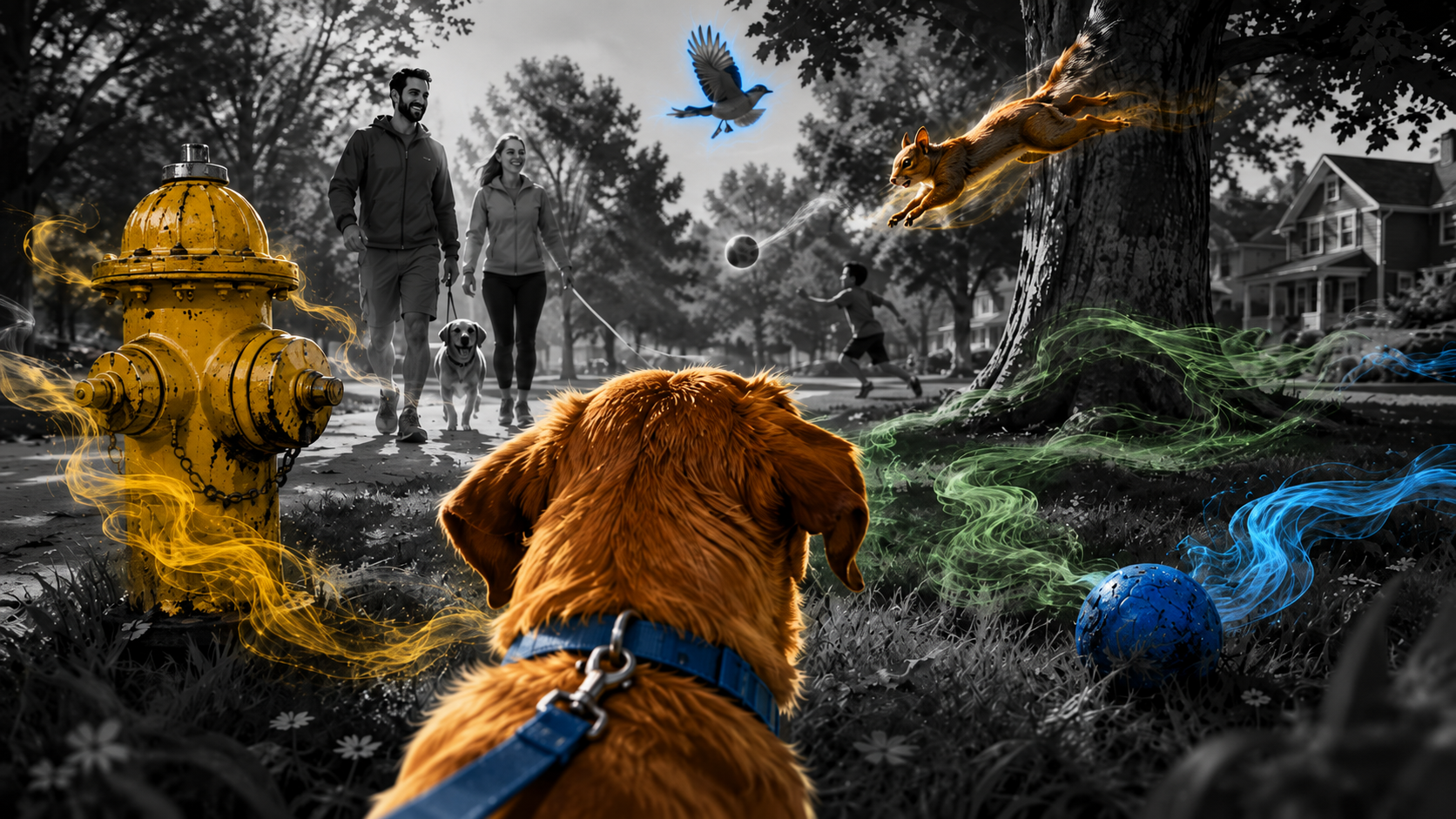
Dogs share our homes, our routines and often our beds, but the world they experience is remarkably different from the one humans know. Their eyes process color differently, their vision favors movement over fine detail, and their noses provide information so rich that sight may not even be their most important sense.
Understanding how dogs perceive their surroundings can help owners make better choices about toys, training, walks and even home environments. It also offers a fascinating glimpse into what everyday life might be like from a dog's point of view.
Dogs Don't See Only in Black and White
One of the most persistent myths about dogs is that they see the world entirely in black and white. They do see color, although their palette is more limited than ours.
Humans normally have three types of color-sensitive cone cells in the eye. Dogs have two. Their color vision is often compared to red-green color blindness in humans.
Dogs are especially good at distinguishing blues and yellows. Reds, oranges and greens can be harder for them to separate. A bright red ball thrown onto green grass may appear much less dramatic to a dog than it does to its owner.
That is worth remembering when choosing toys. A blue or yellow toy may be easier for a dog to spot against grass, carpeting or other backgrounds.
Their World Is Less Detailed
Dogs generally do not see fine detail as sharply as humans do.
A person with normal vision may clearly identify an object from a considerable distance while a dog needs to be closer before the same object becomes distinct. This does not mean dogs have poor vision. Their eyes simply evolved for different priorities.
Humans rely heavily on recognizing fine shapes, reading facial expressions and examining objects closely. Dogs developed as hunters and scavengers whose survival often depended more on recognizing movement and locating animals than reading tiny details.
A person standing far down the street may therefore look relatively indistinct to a dog. The dog's ears and nose may identify that individual before its eyes provide a clear picture.
Movement Matters
Dogs are particularly sensitive to motion.
An object that is difficult for a dog to notice while sitting still may suddenly become obvious once it begins moving. This ability would have been especially valuable to canine ancestors hunting small animals or watching for danger.
It also explains why some dogs become intensely interested in squirrels, bicycles, running children or leaves blowing across a yard.
Movement can capture a dog's attention even when the moving object is relatively far away.
Owners can use this tendency during play and training. Moving a toy along the ground, for example, may attract more interest than simply placing it in front of the dog.
Dogs Handle Dim Light Better Than We Do
Dogs are generally better equipped than humans to see in low-light conditions.
Their eyes contain a reflective structure called the tapetum lucidum. Light entering the eye can reflect back through the retina, giving light-sensitive cells another opportunity to detect it.
This structure contributes to the familiar glowing appearance of a dog's eyes when they are illuminated by headlights, flashlights or camera flashes at night.
Dogs also have relatively large pupils and a high proportion of rod cells, which help with vision in dim conditions.
They cannot see in total darkness, but twilight, moonlight and a dimly illuminated room may provide more useful visual information to a dog than a human might expect.
A Dog's Field of Vision Can Be Wider
The position of a dog's eyes can influence how much of the surrounding world it can see.
Humans have forward-facing eyes that provide excellent depth perception but a relatively narrower field of view. Many dogs have eyes positioned slightly farther toward the sides of the head.
That arrangement can give them a broader view of their surroundings.
The exact field of vision varies considerably among breeds. Dogs with long, narrow heads may have a wider peripheral view than breeds with short, broad faces.
Their visual experience therefore is not identical from breed to breed. A greyhound and a pug are not necessarily looking at the world through the same visual geometry.
Smell May Matter More Than Sight
Trying to understand a dog's world through vision alone misses perhaps the biggest difference between canine and human perception.
Humans tend to experience the environment visually. We walk into a room and immediately notice furniture, people, colors and objects.
Dogs often investigate that same room with their noses.
Their sense of smell can reveal who recently passed through an area, whether another animal was present, what someone has eaten and countless other clues humans cannot detect.
A neighborhood walk therefore is not simply exercise. To a dog, every tree, mailbox and patch of grass may contain information.
That is why a dog stopping repeatedly to sniff may not be wasting time. The dog is gathering information about its surroundings.
For a human, the experience might be roughly comparable to walking through a neighborhood filled with constantly changing signs, messages and photographs.
Dogs Also Watch Us Closely
Although dogs may not see details as sharply as humans, they are remarkably skilled at interpreting human behavior.
Domestication has given dogs thousands of years of experience living alongside people. Many learn to recognize gestures, body posture, routines and subtle changes in behavior.
A dog may know that shoes and car keys mean someone is leaving, that a leash signals a walk or that a particular movement toward the kitchen could mean dinner is coming.
Dogs can also learn to follow pointing gestures and watch faces for information.
Much of what looks like intuition may actually be careful observation combined with an extraordinary ability to learn patterns.
Seeing the World Like a Dog
Imagining canine vision can change how owners think about everyday situations.
A dog hesitating on a dark staircase may genuinely have difficulty interpreting what lies ahead. A bright red toy may disappear visually against certain backgrounds. A rapidly moving object may be much more exciting than a stationary one.
Meanwhile, the dog's nose is continuously providing an entirely different layer of information that humans barely notice.
Dogs do not experience an inferior version of the human world. They experience a different world — one built around movement, scent, sound and selective visual information.
The next time your dog pauses during a walk, stares toward something you cannot see or spends several minutes examining one seemingly ordinary patch of grass, remember that your companion may be experiencing details you simply cannot detect.
Humans may admire the scenery.
Dogs are reading the neighborhood.
========
Marina Ellsworth writes about animals, everyday science and the surprising ways familiar creatures experience the world. She enjoys translating research about animal behavior into practical insights for pet owners. This article was written, in part, utilizing AI tools.








Comments