Are You My Momma? 7 Stories of Animals Who Raised Babies Outside Their Species
Published in Cats & Dogs News
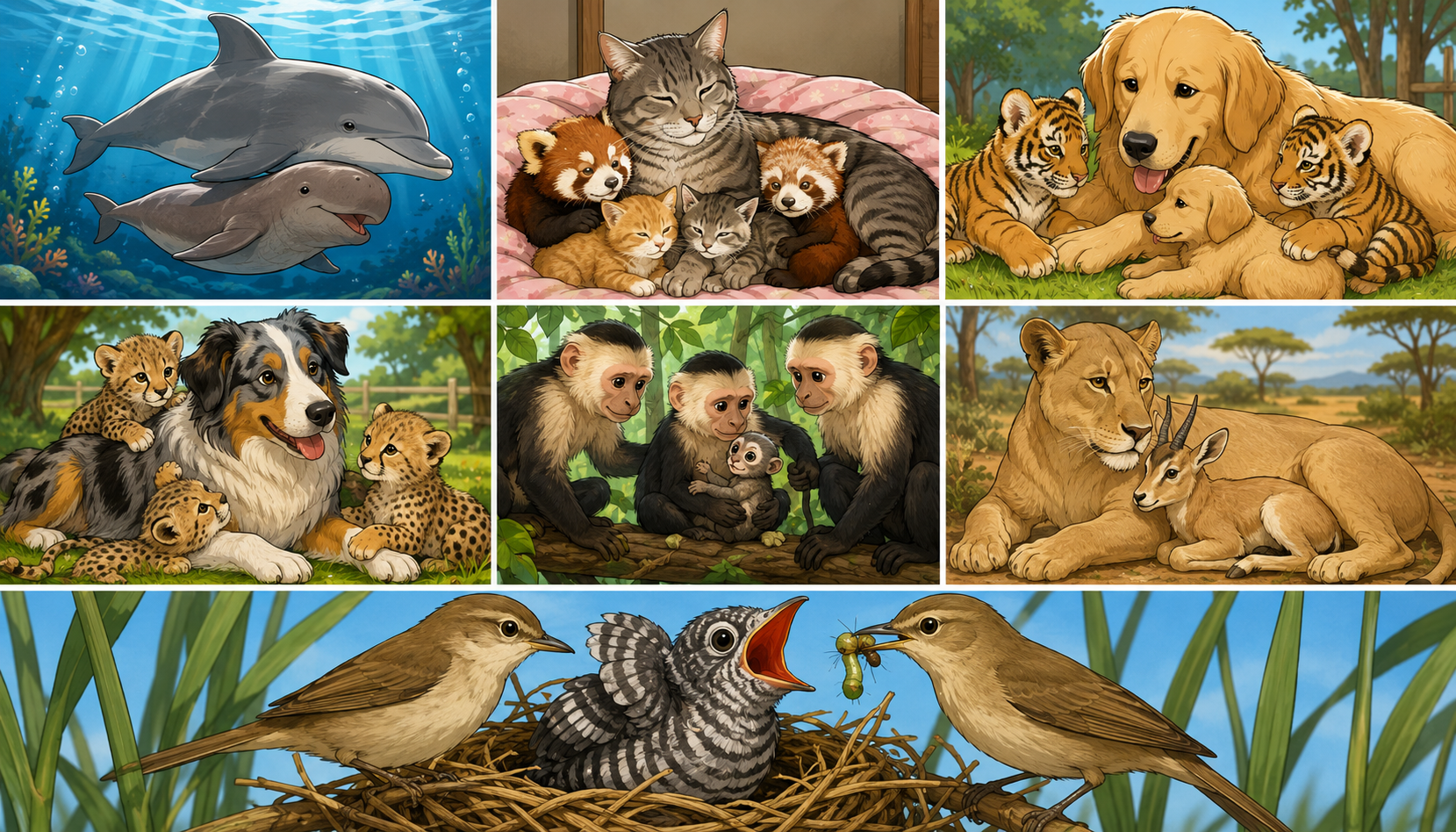
Motherhood in the animal kingdom usually follows a straightforward rule: Take care of the babies that look, smell and sound like you.
Every so often, however, an animal apparently forgets to read the rulebook.
Across zoos, forests, oceans and savannas, researchers and animal caretakers have documented remarkable cases of animals protecting, feeding or effectively adopting youngsters belonging to entirely different species. Sometimes the behavior appears maternal. Sometimes it is driven by powerful nurturing instincts. And occasionally — as with one famously manipulative bird — the foster parents never volunteered for the job at all.
Here are seven memorable cases in which the family resemblance was decidedly optional.
1. A dolphin adopted a baby whale
Perhaps one of the strongest documented cases of cross-species adoption occurred in the waters around French Polynesia.
Researchers studying bottlenose dolphins discovered an adult female caring for a young melon-headed whale. Even more remarkably, the dolphin already had a biological calf of her own.
The whale calf remained with its adoptive mother for years, swimming alongside her, socializing with bottlenose dolphins and even adopting some behaviors more typical of dolphins than melon-headed whales. Scientists reported that the youngster was fully integrated into the dolphin community.
Marine mammals commonly show complicated social behavior, but long-term adoption of a youngster from another species is exceptionally unusual. The relationship provided researchers with a rare glimpse of just how flexible those social bonds can become.
2. A house cat became mom to a red panda
In 2008, a red panda at Amsterdam's Artis zoo rejected her newborn cubs. One of the zoo's keepers happened to have a house cat that had recently given birth.
The solution sounds like something from a children's book: Put the baby pandas with the kittens.
The cat accepted them.
She allowed the tiny red pandas to nurse alongside her own kittens. One panda cub was too weak to survive, but the other continued receiving maternal care from its feline foster mother until it was old enough to begin eating solid foods.
Considering that a newborn red panda isn't dramatically different in size from a kitten, perhaps the cat simply concluded that she had been given one particularly strange-looking child.
Whatever her reasoning, dinner was apparently dinner.
3. A dog raised tiger cubs alongside her puppy
Domestic dogs may deserve a special award for serving as substitute mothers to zoo animals.
At the Royev Ruchey zoo in Krasnoyarsk, Russia, a dog named Palma nursed tiger cubs whose mothers would not care for them. Palma already had a puppy of her own but accepted the considerably more exotic additions to her family. Reuters photographed her interacting with both Amur and Sumatran tiger cubs.
Cross-fostering works particularly well when the surrogate is already lactating and willing to accept unfamiliar newborns.
There is, of course, one obvious complication with raising tigers as puppies: The puppies eventually become tigers.
4. Blakely the dog became a professional foster dad
Not all surrogate mothers are mothers.
Blakely, an Australian shepherd at the Cincinnati Zoo, became something of a professional foster parent to young animals that needed additional social development.
In 2016, five cheetah cubs lost their mother after she failed to recover from complications following a cesarean section. Zoo staff handled feeding, but Blakely supplied something people could not duplicate quite as easily: animal parenting.
The cubs climbed over him, wrestled with him and learned social boundaries through their interactions. Zoo officials said Blakely's role would evolve from providing warmth and exercise to teaching behavior as the cubs developed. He previously helped rear other zoo babies, including a young takin and another cheetah.
Apparently, some dads don't care what species is listed on the birth certificate.
5. Capuchin monkeys adopted a marmoset
Humans weren't involved in one of the most fascinating cases of interspecies adoption recorded among primates.
Scientists observing wild capuchin monkeys in Brazil reported that the group accepted an infant common marmoset. Researchers documented the extraordinary case in the American Journal of Primatology.
The little marmoset became socially integrated into the capuchin group and was cared for by foster females despite belonging not merely to another species but another primate genus.
Later reviews of friendly relationships among primates have highlighted the case as an especially striking example of caregiving extending beyond species boundaries.
For an animal living in a complex social group, apparently "one of us" doesn't always require looking like everyone else.
6. A lioness repeatedly adopted animals she normally would eat
Few cross-species relationships were as improbable as the one involving Kamunyak, a lioness living in Kenya's Samburu region.
Beginning in the early 2000s, Kamunyak repeatedly adopted young oryx — animals that would ordinarily qualify as lion prey.
Instead of hunting the calves, she guarded them.
Wildlife observers were particularly astonished when Kamunyak allowed the biological mother of one calf to approach and nurse it before driving the adult oryx away again. Her behavior suggested she was not simply confusing the youngster with a lion cub.
She eventually repeated the behavior with several calves.
The arrangements did not always end happily, and Kamunyak could not provide the milk the calves needed. Still, the predator's repeated determination to protect young animals belonging to a prey species remains one of the strangest documented examples of cross-species maternal behavior.
7. Reed warblers raise the world's most demanding foster child
Not every cross-species parent signs up willingly.
The common cuckoo has turned foster parenting into an evolutionary strategy.
A female cuckoo lays an egg in another bird's nest and leaves. When the cuckoo hatches, the host parents may proceed to feed and raise the enormous stranger as though it were their own offspring.
Reed warblers are among the species famously exploited this way. A cuckoo chick can eject the warblers' eggs or young from the nest and then monopolize the parents' attention. Researchers have found that the cuckoo's extraordinary begging calls stimulate its foster parents to provide enough food for what amounts to a one-bird imitation of an entire hungry brood.
Unlike the dolphin, cat or dog, the warbler hasn't experienced a sudden burst of interspecies compassion.
It has been conned.
Still, the result is remarkable: Tiny birds tirelessly feeding a baby that may grow several times larger than they are.
Nature, it turns out, has no single definition of family. Sometimes an orphan finds a willing surrogate. Sometimes an animal's nurturing instincts extend beyond the boundaries scientists might expect. Sometimes a predator decides today's potential lunch requires protection instead.
And sometimes Mom is a reed warbler who probably has some serious questions about why her child is six times her size.
========
Maribel Rowan is a freelance writer specializing in the unexpected corners of science, nature and everyday life. She believes the animal kingdom is usually stranger — and considerably funnier — than anything humans could invent. This article was written, in part, utilizing AI tools. No body







Comments