Presidential Cats: 7 Cats Who’ve Made Their Home in the White House
Published in Cats & Dogs News
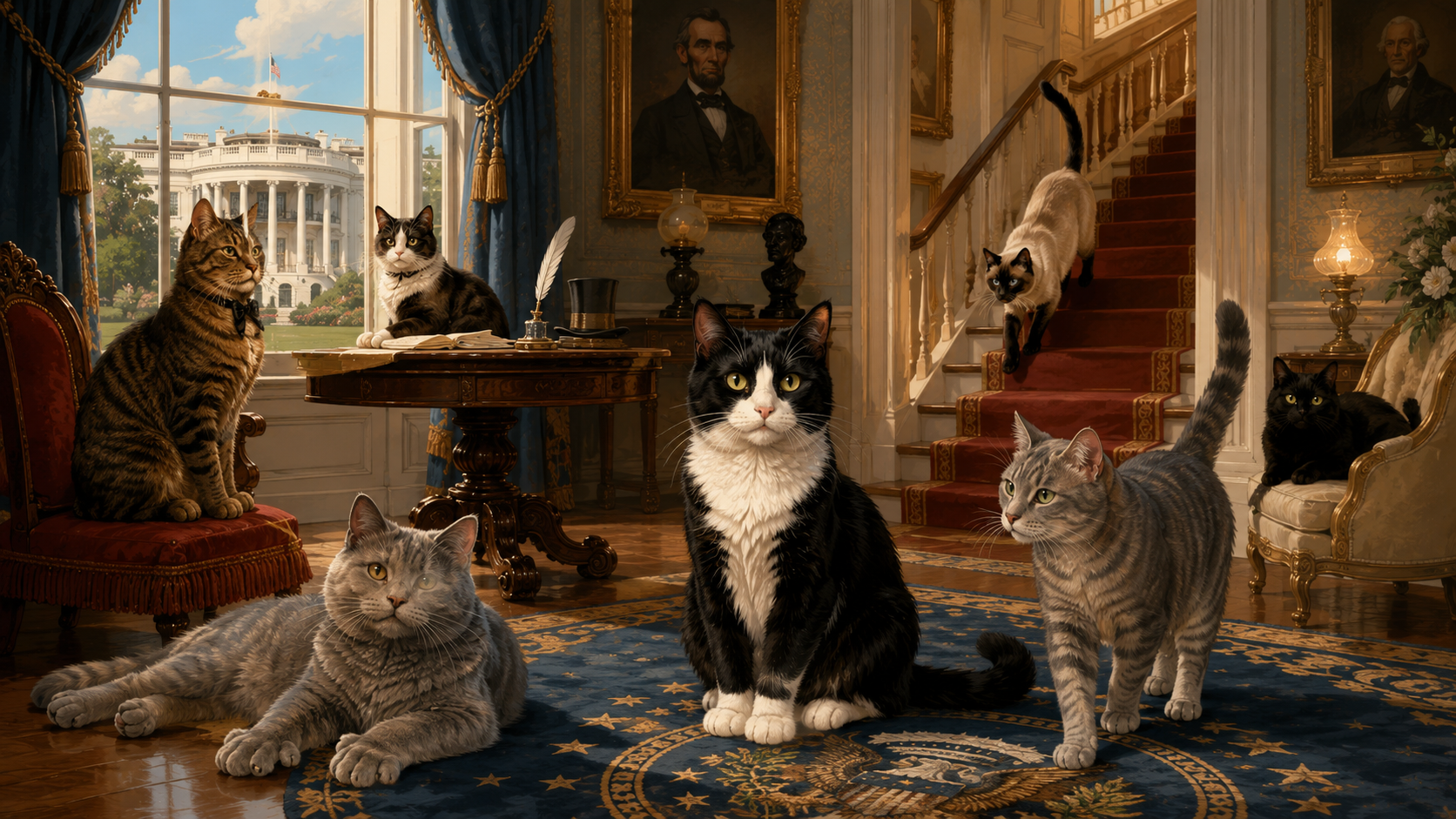
The White House has housed generals, diplomats, first families, visiting monarchs, schoolchildren, reporters and the occasional political crisis. It has also housed cats.
Presidential pets are often remembered as dogs: Franklin D. Roosevelt’s Fala, George H.W. Bush’s Millie, Barack Obama’s Bo and Sunny, or the Biden German shepherds. Dogs tend to campaign better. They sit for photographs, chase tennis balls and offer the kind of loyal public companionship Americans like to imagine in their leaders.
Cats are different. They do not campaign. They do not salute. They do not care about approval ratings. A cat in the White House is a quieter kind of political symbol: domestic, independent, occasionally elusive and utterly unimpressed by power.
From Abraham Lincoln’s Civil War-era companions to Socks Clinton’s celebrity turn and Willow Biden’s modern return, White House cats have added a little softness, humor and mystery to the presidency.
Tabby, Abraham Lincoln’s dinner guest
Abraham Lincoln is often described as the first president to keep cats in the White House, and his affection for them was no small matter. His wife, Mary Todd Lincoln, reportedly said cats were his “hobby.”
One of Lincoln’s cats was Tabby, a gift from Secretary of State William Seward. The cat arrived during one of the most difficult presidencies in American history, when the White House was not merely a residence but a wartime command center.
Tabby became part of family lore because Lincoln reportedly fed the cat at the dinner table. When Mary Lincoln objected, the president is said to have defended the cat’s place by noting that if a gold fork was good enough for a former president, it was good enough for Tabby.
The story may sound like a small domestic scene, but that is the charm of presidential pets. They bring presidents down to human size. Lincoln was carrying the Civil War, but he still made room for a cat.
Dixie, the cabinet rival
Dixie, another Lincoln cat, also came from Seward and also became part of the president’s cat-loving reputation.
Lincoln is said to have claimed that Dixie was smarter than his whole Cabinet. Whether spoken in jest, frustration or simple affection, the line has endured because it sounds exactly like something a tired president might say while surrounded by political quarrels.
Dixie and Tabby are believed to have been the first cats to live at the White House. Their presence also fits Lincoln’s broader tenderness toward animals. He was known for his compassion, and stories of his kindness to cats, dogs and other creatures became part of his public character.
For a president remembered in bronze and marble, Dixie offers something warmer: Lincoln as a man who could look at a cat and find comfort.
Slippers, Theodore Roosevelt’s six-toed cat
Theodore Roosevelt’s White House was famously crowded with children, guests and animals. The Roosevelt family kept dogs, ponies, birds, guinea pigs, snakes and other creatures. It was less a quiet executive mansion than a high-spirited household with government attached.
Among the Roosevelt cats was Slippers, a gray cat remembered for having extra toes. Slippers reportedly had a habit of sprawling in inconvenient places, including White House hallways.
That image is perfect. Roosevelt was a president of action, movement and force. Slippers, apparently, was a cat of strategic obstruction.
The Roosevelt pets helped define the family’s public image. They made the White House seem lively, chaotic and approachable. In that atmosphere, a polydactyl cat lounging where important people needed to walk seems entirely at home.
Slippers was not merely a pet. He was a reminder that even presidents must sometimes step around a cat.
Misty Malarky Ying Yang, Amy Carter’s Siamese companion
Misty Malarky Ying Yang may have had the best name of any White House cat.
The Siamese cat belonged to Amy Carter, the young daughter of President Jimmy Carter and first lady Rosalynn Carter. Misty arrived at a time when Amy Carter’s presence helped make the White House feel like a family home, not just the official residence of the presidency.
Misty became known beyond the family quarters. In 1977, the cat reportedly wandered down the Grand Staircase during a state dinner, passing President Carter and Mexican President José López Portillo. It was the sort of unscripted moment only a cat would attempt.
The Carters’ cat also stands out because there were not many modern White House cats between the Roosevelt era and the late 20th century. Misty helped keep the feline tradition alive before Socks Clinton made presidential cats famous again.
A Siamese cat moving through a formal White House dinner is a perfect presidential-pet scene: protocol, diplomacy and one animal who did not receive the memo.
Socks, the celebrity first cat
Socks Clinton was not just a White House cat. He was a phenomenon.
A black-and-white tuxedo cat adopted by the Clinton family before they moved to Washington, Socks arrived at the White House with President Bill Clinton, first lady Hillary Clinton and Chelsea Clinton in 1993. He quickly became one of the most photographed and recognizable pets in modern presidential history.
Socks appeared in books, on television and in the early White House website era. He became a pop culture figure at a time when presidential image-making was changing. Cameras loved him. Children wrote to him. Reporters followed him. Socks had the air of a cat who understood fame but did not especially need it.
His life at the White House became more complicated when Buddy, a Labrador retriever, joined the family. The two pets reportedly did not get along, giving the press an easy domestic metaphor for Washington conflict.
Still, Socks remains perhaps the most famous presidential cat. He brought feline dignity, mild chaos and camera-ready charm to the Clinton years.
India, George W. Bush’s quieter cat
India, the Bush family’s black cat, had a quieter public profile than Socks, but she also made the White House her home.
India belonged to President George W. Bush and first lady Laura Bush. She had been with the family before the presidency and moved with them into the White House. While the Bush dogs Barney and Miss Beazley often drew more attention, India remained part of the family’s private life.
That lower profile seems fitting. Not every presidential pet becomes a media star. Some are simply household companions who happen to live at one of the most famous addresses in the world.
India’s tenure also marked the last time a cat lived in the White House until Willow Biden’s arrival more than a decade later. Her presence continued a tradition that is sporadic but enduring: Not every administration has a cat, but cats keep returning.
India may not have commanded the spotlight, but she helped preserve the first-cat lineage.
Willow, the modern return of the first cat
Willow Biden brought a cat back to the White House in 2022.
A gray tabby from Pennsylvania, Willow reportedly first caught Jill Biden’s attention during the 2020 campaign when she jumped onto a stage during an event. The cat later joined President Joe Biden and first lady Jill Biden at the White House and was named after Willow Grove, Pennsylvania, Jill Biden’s hometown.
Willow’s arrival was widely covered because presidential cats had become rare. She followed India, Socks, Misty and a long line of earlier cats whose histories were sometimes better remembered than documented.
Her story also had the modern ingredients of a first-pet narrative: campaign anecdote, social media interest, official announcement and instant public affection. Americans may argue endlessly over presidents, but many will pause for a good cat story.
Willow reminded the country that the White House is not only an office. It is also a residence, and residences are improved by animals.
The cat’s role in presidential life
Presidential cats do not project loyalty the way dogs do. They do not fetch, guard or perform. That may be why they are so appealing.
A cat in the White House suggests that even inside a building built for ceremony and power, ordinary domestic life continues. Someone fills a bowl. Someone opens a door. Someone removes cat hair from clothing before a meeting. Someone discovers that the most powerful person in the country still cannot make a cat do anything it does not wish to do.
That is a useful kind of humility.
From Tabby and Dixie to Willow, presidential cats have occupied a small but memorable place in American history. They have interrupted dinners, charmed photographers, lounged in hallways and ignored the machinery of government.
Presidents come and go. Administrations rise and fall. But a cat, given the chance, will still find the warmest room in the White House and act as if it owns the place.
========
By Celia Harrow Celia Harrow is a history and lifestyle writer who focuses on American homes, public figures and the animals that make famous places feel human. She writes about the small domestic details that reveal larger stories. This article was written, in part, utilizing AI tools.
[1]: https://www.whitehousehistory.org/here-kitty-kitty?utm_source=chatgpt.com "Here Kitty Kitty"



Comments