Black and brown parents revisit 'the talk' with their children as school year unfolds
Published in Lifestyles
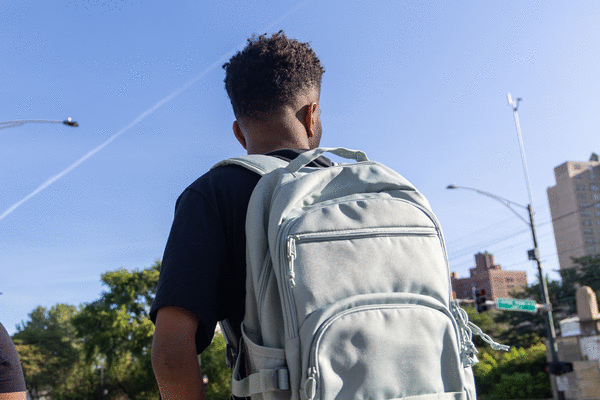
CHICAGO — As students settle into the school year and “new normal,” parents take the journey with them — lending support and guidance as the back-to-school season unfolds amid the surprises and challenges everyday school interactions bring. Sometimes navigating the school year feels like a “Choose Your Own Adventure” book, where one decision could quickly spiral into devastating results and alter the course of a young person’s life.
One thing, however, remains constant: “the talk.”
It’s the conversation Black and brown parents have been having for generations with their children on how systemic racism and racial profiling can turn deadly in an instant. It’s a message they share with their children to equip them with the necessary knowledge to protect themselves from being hurt or killed during everyday activities that turn into racialized encounters with police and others.
Joy Sapp, a Chatham native, remembers having “the talk” when her eldest, Robert Wise III, 17, was 9 and her youngest, Elliott Donaldson Jr., 13, was 5. Parents like Sapp are revisiting the talk and now including friends — all to make sure their children stay safe, recognize pervasive biases, de-escalate scenarios they may encounter and remove themselves from situations that run counter to their well-being.
The conversations — online and in real life — have been particularly significant in recent months after the death of Nolan Wells, the Black teen who traveled to an uninhabited island off of Mississippi’s Gulf Coast on a July Fourth boat trip with a group of friends, all of whom were white. He did not return to the mainland with his friends; instead, his body was found two days later off the island’s coast.
Questions have swirled around Wells’ death from his family, his legal representation and the Black community, who were suspicious about law enforcement moving too quickly with the investigation and assuming foul play wasn’t involved, while being slow in relaying new information to the public. An independent autopsy commissioned by Wells’ family found in July that the 18-year-old’s cause of death was “undetermined” pending further investigation. A Mississippi grand jury decided not to bring indictments in the case last month.
“You have to keep a watchful eye,” Sapp said. “I tell my kids all the time: You are the company you keep, so if you’re around friends and they’re doing something they’re not supposed to, you need to distance yourself or let somebody know. You have to make sure these are your friends, because he (Wells) thought that these were his friends and we’re seeing now that that wasn’t really evident.”
This summer, Jamie Nesbitt Golden learned about an interaction her 16-year-old son, Langston, had with law enforcement at a South Side bus stop on his way home from work. It sparked the Block Club Chicago reporter’s ire and prompted her to write a Facebook post about it.
Having missed his usual stop, he got off at the next one when a blue, unmarked Ford Explorer pulled up with two plainclothes officers — one Black, the other white.
“I had assumptions of them thinking I was suspicious because they couldn’t see that I was on the phone and I was hunched over,” the Kenwood High School junior said. “They approached me and told me that they were checking on my well-being. They asked if I had a weapon on me. I’m like, ‘No.’ I told them I don’t live in the area.”
Golden recalled the interaction taking no more than five minutes, but he thinks about the mistakes he made — steps his parents told him not to take when they gave him “the talk.”
One was walking closer to those who say they are law enforcement. His mother told him to maintain distance because he didn’t know whether they were real cops. Having covered Immigration and Customs Enforcement as part of her job, she said she worries about folks impersonating law enforcement officers.
Another mistake was conversing with law enforcement officials without a parent listening in. The interaction ended when a young woman interrupted. As Golden said, “She sort of shooed them away.”
“I didn’t feel threatened for my life. … I was irritated,” he said of this, his first intense interaction with the Chicago Police Department.
His parents sent him to work in Ubers for a few days after that, as a precaution. He took the train for the remainder of his summer program. Golden said she is following her son’s lead on navigating the aftermath of the incident, which may entail lodging a complaint with the police.
Riana Elyse Anderson, a licensed clinical psychologist and associate professor at Columbia University’s School of Social Work, looks at proactive coping strategies to reduce race-related stress in Black families as the CEO and founder of RACE Space Inc., which hosts the mental health app Teens Navigating the Talk, designed by clinicians, researchers and youths of color to improve teens’ ability to talk about, cope with, and confront racism.
She sees the Wells case as nuanced.
“I can’t say that there’s nothing racial about it, and I don’t want to say that this isn’t a racial issue,” she said. “At the same time, adolescents make hella mistakes all the time and try to cover it up. This is not something that we can put our finger entirely on, and we can’t lose sight of it at the same time.”
Nesbitt Golden said Langston takes part in TMH Mancave, a weekly boxing and mental health program, with a peer group of other high school-age kids. The program aims to eliminate stigma and bring awareness to the mental health needs of Black men and boys. He said the group spent a day talking about the Wells case.
“Kids, for the most part, are resilient,” she said. “We’ve been having these conversations since he was in first or second grade. When he came home that day … when he told me he had approached the car because he couldn’t hear, my blood ran cold. We tell him, ‘Don’t answer any questions, ask for a parent.’ But you have to give a little grace because as soon as you’re in that situation, everything you’ve been taught goes out the window because you’re trying to figure out what to do. I had that moment on Facebook because I was so upset about it.”
In high-stress situations, Anderson said, the rules laid out in the talk don’t always translate into action.
“We can’t say definitively what Nolan did or didn’t do,” Anderson said. “But what I can say is that when families have these conversations with young people, their psychological well-being tends to be better, because these young people are processing, and when they do react, it’s not as much of a spike in adrenaline, stress or cortisol. It’s a recognition and awareness of that situation, and that keeps them more regulated in their ability to process.”
Both Sapp and Nesbitt Golden said the talk remains a necessary mainstay as their boys get older.
“All we can do is continue to have these conversations,” Nesbitt Golden said. “Keep stressing that there are ways to navigate this. … It’s not just what happens when you are stopped by cops, but what happens when you’re at a party and something happens and you don’t feel safe? How do you leave that?”
“There are too many Black and brown kids that aren’t making it home,” Sapp added. With a son soon to be in college, she said she’s doubling down on making sure he’s aware of his surroundings. “Going to parties. You have to watch your cup, … the people you hang around. You have to be careful.”
It’s never too soon to have “the talk,” Anderson said. Points of entry are many, given that literature exists to help adults have developmentally appropriate conversations with youths on the topic.
“If they could pick out which Starburst (candy) they like, they get the concept of discrimination,” Anderson said. “They know how to pick amongst things that they like and don’t like. It’s about how you can use your own sense of their understanding to link into that conversation.”
Anderson has built a program for Black families to talk to each other about this — specifically for those 10 to 14 years old. In it, people talk about and unpack feelings, and ask questions of youths: “What did you notice? How can I help you to think about this more clearly?”
“You don’t have to have all the answers,” she said. “If you can say ‘I love you and I want to make sure that you’re OK. Talk to me about how you feel about this thing.’ I think that’s a really helpful kick-start for family conversations.”
©2026 Chicago Tribune. Visit at chicagotribune.com. Distributed by Tribune Content Agency, LLC.






















Comments