Harvard students are already stressing over the crackdown on A's
Published in Lifestyles
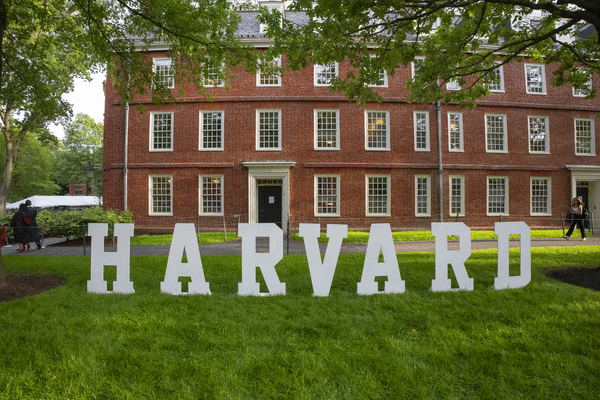
Harvard University’s policy capping A grades among undergraduates doesn’t officially start for another year, but students heading back to school this fall are already fretting over the changes.
After Harvard’s Dean of Undergraduate Education urged faculty to start implementing the policy as soon as the coming semester, students who’d registered for classes earlier in the year started rethinking their courses.
Some have scoured dedicated websites for so-called “gems,” which have typically combined lower workloads with potential for high marks. Possibilities include: Chocolate, Culture, and the Politics of Food; What Disease Teaches about Cognition; and Elves, Fairies, and UFOs: Dangerous Encounters with Otherworldly Beings in Folklore — though it’s unclear how such courses could change under the new system.
Professors are also planning how they’ll differentiate student work and some, especially those on a tenure track, are worried about their crucial student reviews. Will undergraduates still sign up for their courses if they’re perceived as more challenging, and might their all-important scores on sites like RateMyProfessors.com suffer?
It all comes down to a divisive new metric, which has become known by its shorthand as it flies around the group chats on campus: “20%+4.”
From September 2027, no more than 20% of a class — plus four additional students — can receive an A grade. The new policy was approved in May by 70% of Harvard faculty in the school of arts and sciences, in one of the strongest moves against grade inflation in US higher education in decades. In the academic year that ended in mid-2025, roughly 60% of undergraduate grades at the Ivy League school were an A.
Rising grades have drawn scrutiny from critics, including some within the White House, who say the lack of distinction makes it harder to evaluate students and shows a pivot away from merit-based assessments. The vast majority of students oppose the policy, according to a survey by the Harvard Undergraduate Association.
Colleen Meosky, a rising junior studying history and psychology, said she had originally planned to branch out and take a harder course to fulfill her science and engineering requirement. Now, she worries that her lack of foundation would be a challenge and is more likely to stick to subjects she already knows.
“I’m just not being as adventurous as I was my first year,” said Meosky, from Buffalo, New York. “I don’t see learning for the sake of learning outweighing future job prospects.”
‘Wiggle Room’
The new grading policy was passed in May. By late June, Amanda Claybaugh, an English professor and Harvard College’s Dean of Undergraduate Education, was emailing faculty to recommend they begin using the new system early to prepare.
“I urge you to follow the cap this fall,” Claybaugh wrote, according to an internal memo that was viewed by Bloomberg.
“We should keep in mind that the goal is not to award as many A’s as possible without going over,” she continued. “Instead, we should set standards that fewer than 20% of students could meet — or 20% in an unusually strong year, with the +4 as additional wiggle room.”
She also listed several courses that would aim to stay under the cap in the coming semester, including introductory computer science, economics and math classes.
“Everybody wants an A because they think that an A gets you a job at McKinsey or Google,” Claybaugh said in an interview. “But if everybody gets A’s, then an A is no longer enough.”
“So we actually have an obligation to be very clear with the external world about who our very best students are,” she said. “We also have an obligation to our students to be giving them very clear information about their performance and where they stand and what their strengths are.”
With Harvard out in front, other Ivy League schools may not be far behind. Faculty at Columbia University have been considering undergraduate grading changes, and a Dartmouth College committee on grading practices and assessment will report its initial progress to the faculty this winter. At Yale University, an April faculty report said grades had become “meaningless as an academic measure” and recommended establishing a 3.0 as the mean grade point average.
And while a Princeton report last year found that two-thirds of grades awarded for undergraduate coursework were in the A range, the college’s dean told the Daily Princetonian earlier this year that he had no plans to change grading policy. A previous, decade-long attempt to limit A-level grades at the school was abandoned in 2014.
Other universities are moving away from letter grades. Beginning in the fall of 2027, freshman at the University of Michigan’s College of Literature, Science and the Arts will receive a “pass” or “no credit” for their first semester at the school.
Tough Competition
Though Harvard’s fall semester doesn’t start until Sept. 2, many returning students have an earlier date saved in their calendar. In late August, the portal to register for courses will reopen, giving students a chance to switch out classes they originally signed up for months ago.
Competition is likely to be tough for classes that are perceived as easier, or for small-group seminars where a larger number of students would fall within the cap. Some may ultimately find they don’t have much choice, especially since incoming freshmen can register for classes as soon as this week.
It’s around this time of year that Jay Chooi, a Rhodes Scholar who graduated from Harvard College in May, has typically seen a spike in traffic to a website he created that ranks courses based on student ratings, workload and review comments. Hugems.net has used internal Harvard feedback to identify classes that combine just a few hours of work per week with great student reviews, some of which strategically use the word ‘gem’ — Harvard slang for an easy A — to help others find them.
L.A. Karnes, a rising junior, said the new grading policy meant she was looking for classes that would fulfill course requirements without being too challenging for a student who’s not overly familiar with the subject matter.
A course called “Ballots and Bibles,” which looks at the links between scripture and American political rhetoric, looked like it might fit the bill, Karnes said. She had already done most of the readings in other classes and figured that would help her be in the top 20% of students.
For faculty members, especially those on a tenure track, the definition of a gem might be slightly different: packed and popular classes where they can hand out good grades that help with glowing evaluations from students.
“Without the cap, each faculty member has an incentive to raise grades in their own class, for instance, to increase enrollments,” said David Laibson, an economics professor.
Laibson co-chaired a committee that issued a 2025 report that described problems in Harvard’s classrooms and a set of recommendations for addressing them. Some of the conclusions of its report were damning: Harvard undergraduates admitted to picking classes based on perceived easiness rather than intellectual interest and shying away from difficult conversations, while instructors said students often didn’t attend class or do many of the assigned readings. They also seemed overwhelmed by extra-curricular activities and expected more flexibility than had been typical before the Covid-19 pandemic.
The report helped lay the groundwork for the grading overhaul, after years during which more lenient grading had been seen as a way to ease anxiety among high-achieving students. At 60%, the rate of A grades in the 2024 to 2025 academic year had skyrocketed from about a quarter two decades earlier.
Still, grade inflation hasn’t affected all majors equally. The median share of A grades awarded in the Arts and Humanities division from 2015 through 2025 rose by more than those in Social Sciences or Sciences, according to internal grading data viewed by Bloomberg.
“Grade inflation also creates a different type of anxiety for students,” said Alisha Holland, a professor in the government department who was part of a subcommittee that developed the grading proposal.
She described students as being “heartbroken” over an A-minus grade, and worried that the mark could have an impact on their job prospects or graduate school admissions.
The change is already making Noah Bryan’s summer a little more stressful.
The rising sophomore from Toronto, who hopes to attend medical school, started studying for his organic chemistry class during any spare moment during his job at the Hospital for Sick Children.
“I’ve got to maximize on the potential to get A’s while I still can,” said Bryan. “Grades are kind of the be-all and end-all for my career.”
In some professions, though, prospective employers see grade point averages as only one metric among many that can prepare a candidate for the workforce, according to Brian Myerholtz, the global head of talent acquisition at consultancy BCG.
“Straight A’s is not something we use as a detriment to someone’s application, but we may look for other reasons, or ask in interviews to tell us about a time something did not go well for you, and what did you learn about that?” said Myerholtz. “Perfection is not the goal.”
‘More Demanding’
Faculty have already been thinking about how they can change their courses to meet the new requirements.
Rebecca Nesson, who teaches a large introductory computer science class, used the spring final exam and other assignments to think about grading under the new policy. The final exam ended up being easier than she expected. The process showed her how much care needs to be taken when finding ways to distinguish student work.
“That made me think about the challenge that our faculty will be facing,’’ said Nesson, who is not a voting member of faculty but supported the grading changes. “Students who truly distinguish themselves and students who were doing very good work were receiving the same grade.”
Karen Thornber, a literature professor who voted in favor of the policy, is spending part of her summer redesigning her general education course that explores mental health and mental illness through literature, the arts and cultural history.
It’s the most significant revision of a course that she’s ever done, partly because of artificial intelligence but also with an eye towards the grading policy. As well as essays or memoirs, students will also be able to create a podcast or a film as part of an assignment, using a different set of skills.
“The course is also becoming more demanding,” she said. “We didn’t feel empowered to do that. We’re under tremendous pressure from students to give A’s.”
A professor at Harvard Business School and in the economics department is thinking about his expertise in game theory and market design as he approaches his graduate course, which is also open to undergraduates. Scott Duke Kominers said one option would be to curtail undergraduate enrollment within the larger class to just five students, so they’d all have the opportunity to earn an A.
“Everyone is trying to optimize,” said Kominers, who’s not a voting member of the faculty of arts and sciences, but said he would have voted against the grade cap. “I also think we can expect to see a lot of risk aversion in the first years of the new policy.”
One hope for students? While the rules for A grades are set, there is no constraint on the number of A-minus grades that professors can hand out.
“We’ll be restoring pride in receiving an A-minus,” Nesson said.
©2026 Bloomberg L.P. Visit bloomberg.com. Distributed by Tribune Content Agency, LLC.




















Comments