Heidi Stevens: A glimpse at Warsaw history reinforces why books and literacy are vital for democracy
Published in Lifestyles
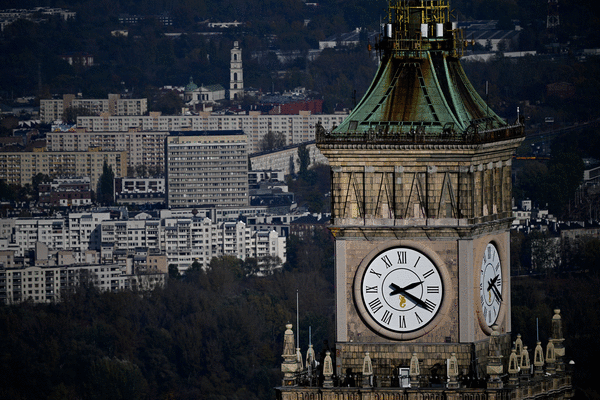
I recently traveled to Warsaw, Poland, for the fourth annual international Literacy for Democracy conference. Organized by the Polish nonprofit Universal Reading Foundation, the conference advocates for programs and policies that promote literacy across all ages, arguing that literacy isn’t just a cultural matter, but a survival factor for democracy, mental stability and economic success.
When I’m not writing this column, I work for the TMW Center for Early Learning + Public Health, a nonprofit research institute at the University of Chicago that works to understand and promote healthy brain development in the first five years of life.
As you can probably guess, just about every neural connection that promotes lifelong literacy catalyzes (or doesn’t) in those first five years. It was in that role that I attended the conference.
Leaders from across the world showed up to exchange ideas for promoting and protecting reading — a refreshing and hopeful departure from watching world leaders exchange much more nefarious ideas.
Tomasz Makowski, director general of the National Library of Poland, told us that one of the highest compliments you could pay a person in 16th century Poland was to compare them to a library: Full of ideas and knowledge. Never boring.
I love that.
Before the conference began, a group of us were invited on a guided tour of the Palace of the Commonwealth, a 17th century Baroque palace in Krasiński Square that was mostly destroyed during World War II and reconstructed in the mid-20th century.
It houses a permanent collection of rare works from Poland’s national book collection, including manuscripts dating to the 8th century as well as the original Constitution of Poland from 1791 — the world’s second oldest written constitution, after that of the United States.
Following the tour, our guide told me she heard that book bans are growing in the United States. I told her that’s true. The number of banned books has doubled in the past year, according to PEN America.
“Why?” she asked me, wide-eyed.
I didn’t have an answer for that.
Kasey Meehan, director of PEN America’s Freedom to Read program, had this to say in a new report about the rapid increase in book bans: “This latest trend shows an embrace of anti-intellectualism, undermining public knowledge by devaluing education and expertise.”
The report found that 3,743 unique titles were removed from school libraries and classrooms from July 1, 2024, to June 30, 2025. Twenty-nine percent of those titles were nonfiction, including “Night” by Holocaust survivor Elie Wiesel and “Aztec, Inca and Maya,” by Elizabeth Baquedano, which chronicles the history and beliefs of ancient civilizations.
PEN America tracked 6,780 instances of bans across 23 states over the yearlong span.
“The normalization of book bans echoes conditions long associated with the rise of authoritarianism,” the report says. “As censorship sweeps books from library shelves, the rippling consequences ultimately impact all of us.”
Two days before the conference, my colleague and I took a guided walking tour of Warsaw. For three hours, we learned mostly about the cruel history of the Warsaw ghetto, the largest Nazi-established ghetto in occupied Poland during World War II.
It held about 460,000 Jewish people, many of whom died from starvation or disease. Most of those who didn’t were shot point blank or shipped to extermination camps.
Our brilliant guide, Marlena, delivered this history with humanity and candor. She told us that immersing herself in the required courses to become a tour guide gave her a fuller picture of her native country, as well as a thirst to know more.
“The more knowledge I gain,” she said, “the less certain I am about anything I know.”
Her words bounced around in my mind two days later when I sat in a once-bombed-out palace, next to centuries-old texts, surrounded by people gathered in service of literacy, after fumbling to explain why my own nation bans books.
Here’s another thing: The week before I left for Poland, I had two back-to-back events where I interviewed authors on stage.
First, Mary Claire Haver about “The New Perimenopause: An Evidence-Based Guide to Surviving the Zone of Chaos and Feeling Like Yourself Again,” and then Nickolas Butler about his latest novel, “Forty Year Kiss.”
At the Haver event, 700 or so people packed an auditorium in search of answers and community. I ran into a dear friend whose daughter is living valiantly with an inoperable brain tumor. On the way out, I saw a friend who survived breast cancer. We ran the same Chicago Marathon in 2023 and her strength and joy powered me through some of my more self-pitying miles.
At the Butler event, a couple hundred folks filled a park district event space to hear and talk about late-in-life love, second chances and the moments that add up to a whole, authentic life.
Toward the end, Butler shared a story about walking his land in rural Wisconsin under the moonlight and grabbing handfuls of berries off their vines and feeding them to his dog and eating handfuls himself.
He told us he knew fully and truly that evening that no amount of Jeff Bezos-level wealth could possibly bring him a moment so pure and perfect.
Those words, those nights, were bouncing around in my head while I sat at the conference.
We put so much of what’s precious at risk when we ban books. When we take away the voices and stories and witnesses who can help us understand one another and connect to one another and take better care of one another.
A whole lot of what’s fraying right now can be repaired by stitching ourselves together around a common purpose, around our shared humanity. We have the instructions. They’re all written down — what helps, what hurts, what to do, what to never do again.
We should be wary of any attempt to keep us from reading them.
©2026 Tribune News Service. Distributed by Tribune Content Agency, LLC.






Comments