Editorial: If you're not wealthy, you're making concessions on big-ticket purchases
Published in Op Eds
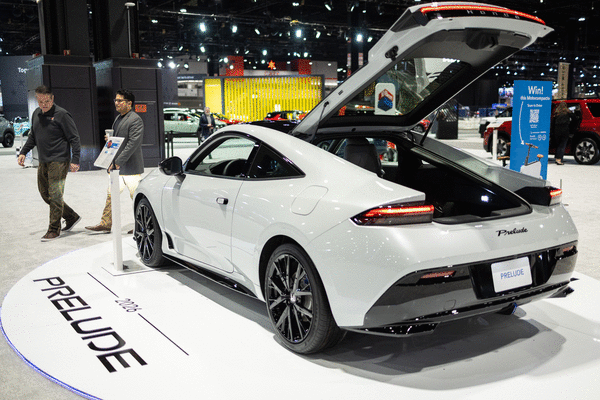
America’s affordability divide is increasingly visible in Americans’ biggest purchases.
The wealthy may be doing just fine. It’s the Americans below them who increasingly are recalibrating what they can afford — a divide now showing up vividly in two big-ticket purchases: cars and houses.
When it comes to nice cars, people accustomed to buying like the rich are increasingly deciding the premium isn’t worth it.
Buyers earning $200,000 or more are the most likely to remain with premium brands, while defection increases as incomes fall, and is strongest among households earning $50,000 to $100,000 and below $50,000, according to JD Power’s Automotive OEM Intelligence Report, released Aug. 6. As JD Power puts it, “affordability is shaping what they buy rather than whether they buy.”
But it’s not all gloom and doom, at least on the vehicle front. Sure, an increasing number of aspirational and middle-income consumers are rightsizing and shifting away from more high-end auto brands, but that’s no tragedy for many. J.D. Power’s APEAL Study found that the satisfaction gap between premium and mass-market brands has fallen from 66 points in 2008 to just 29 points today, with premium brands no longer consistently outperforming on offerings such as dashboard technology and driver-assistance systems.
That’s cars.
Now, let’s do houses.
It’s a much different story here. “The U.S. housing market is splitting in two,” as Zillow Senior Economist Kara Ng put it in a July 29 report.
Luxury-home sales are rising even as starter-home buyers retreat, according to new Zillow data.
At the very top, people really are doing fine. Luxury-home sales rose 6.2% year over year in May, while starter-home sales fell 5.4%, according to the Zillow data. Wealthy buyers are less constrained, but further down the ladder, as interest rates and prices remain high, scraping together the means to buy is much more difficult.
These trends make sense. Anyone who has to depend on a mortgage to buy their first home today has to swallow tacking on hundreds of extra dollars per month compared with the reality just a few years ago.
Zillow researchers reported that a typical starter home nationwide costs about $202,000, a figure well below prevailing home prices in many Chicago suburbs.
A modest three-bedroom, one-and-a-half bath home in northwest suburban Des Plaines listed today at $424,500 comes with a $3,010 monthly payment, if buyers put down 20% and lock in a 6.75% interest rate.
If today’s buyer could finance that same house at 2.96% — the average 30-year fixed mortgage rate during the comparable week in August 2020, according to Freddie Mac — the monthly payment would fall to $2,231, a $779 difference.
How many first-time buyers have more than $9,000 extra a year to throw at the same house?
That equation is a lot different if you can pay cash and avoid the mortgage mess altogether.
Grocery costs get a lot of attention because we feel the pain in the checkout lane so frequently.
Cars and houses, on the other hand, require saving and planning for most folks. And the math — and the plan — looks a lot different these days. Trading down on a car is one thing, but being priced out of buying a home is another story altogether.
_____
©2026 Chicago Tribune. Visit chicagotribune.com. Distributed by Tribune Content Agency, LLC.















































Comments