Commentary: Should we talk about Ariana Grande's body?
Published in Op Eds
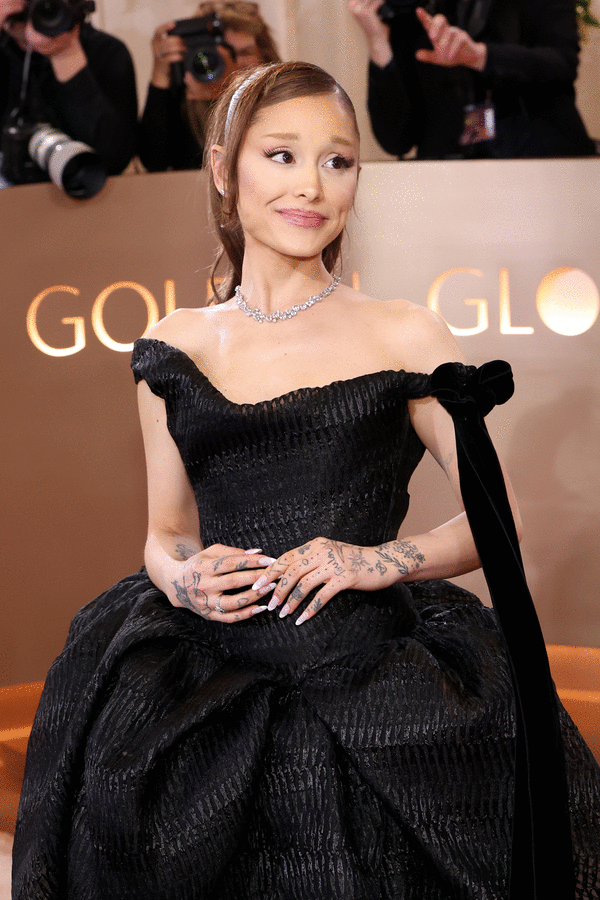
Over the past week, I’ve been inundated with requests from journalists to talk about pop star Ariana Grande’s body. A week ago, Grande blamed “endless, ongoing public scrutiny” for her decision to step back from the public eye at the end of her current world tour. Online chatter about the role Grande’s visibly shrinking body played in this decision has been relentless.
I’m a psychologist who researches how social forces — including body talk — nudge so many young women toward body image struggles and even eating disorders. Yet despite this topic being clearly in my wheelhouse, I was hesitant to respond to the journalists who contacted me. I worried that by even entertaining the question, I might be contributing to the gossipy, body weight-centric chatter that presumably prompted Grande’s decision to take a break from the public eye.
After all, how do you talk about whether we all should talk about Grande’s body without talking about Grande’s body?
I wrote an entire book criticizing our culture’s obsession with women’s appearance. I make the basic argument that we talk about the appearance of women’s bodies, and their body size in particular, way too much. When we focus on how women look, it reinforces a powerful and destructive message that appearance is what matters most about women. Women hear this message loud and clear. In a 2017 Pew Research Center survey of U.S. adults, physical attractiveness topped the list of characteristics our society values most in women. The feeling that your appearance matters more than anything else about you is psychologically corrosive. It makes you focus on your own appearance in a way that can be distracting at best and obsessive at worst. Among girls and young women, chronically surveying the appearance of your own body is a risk factor for the development of eating disorders.
That makes it somewhat ironic that much of the talk about Grande’s body is focused on the possibility that she has an eating disorder. But you cannot tell by looking at someone’s body whether they have an eating disorder. Despite stereotypes that eating disorders are an affliction limited to skinny, rich, young white girls, epidemiological research makes it clear that eating disorders appear throughout age, gender, race and income brackets.
It’s fair to argue that the extreme weight loss associated with one eating disorder — anorexia nervosa — is visible. But there can be numerous reasons for an individual’s weight loss, including health conditions, medication or substance use, extreme stress, or even depression or anxiety.
I do not know if Grande has an eating disorder. I also have no right to know. These disorders are medical conditions, and people deserve privacy when it comes to their health. Even celebrities whose bodies become part of the spectacle of their celebrity have the right to decide what they do and do not share about their health conditions.
Grande’s fan base includes large numbers of teen girls and young women, a group that is especially vulnerable to body image concerns. And it is true that exposure to social media imagery featuring extremely thin celebrities or models can negatively affect girls’ and young women’s body image. This makes it understandable that people are concerned about the message Grande’s extreme thinness sends. But the idealization of thinness in women is deeply entangled with our culture in ways that go well beyond whether you can see a particular celebrity’s collarbones in an Instagram post.
It’s not fair to hold Grande accountable — implicitly or explicitly — for a system of cultural rewards that shapes all of us.
What would I tell all the fans who say they’re talking about Grande’s body size because they’re worried about her or because they hope such comments will prompt her to get treatment for a disorder she may or may not have? Grande undoubtedly has access to people who can facilitate any medical care she may need. She also seems to have family and friends from whom she could seek emotional support. Fans commenting on social media about Grande’s body size may have positive intentions. But no matter how deep their fandom runs, these fans are strangers to Grande. Strangers have no right to dictate what medical care or evaluation Grande needs or ought to pursue.
Even if Grande is struggling with an eating disorder, there’s no reason to think that commenting on her body is helpful. Women’s bodies already receive too much public scrutiny.
Leave eating disorder diagnosis to professionals. Leave Grande alone. Or if that sounds too harsh, simply wish her well and move on.
____
Renee Engeln is a psychology professor at Northwestern University, associate director of the Institute for Adolescent Mental Health and Well-Being and the author of “Beauty Sick: How the Cultural Obsession with Appearance Hurts Girls and Women.”
___
©2026 Chicago Tribune. Visit at chicagotribune.com. Distributed by Tribune Content Agency, LLC.



























Comments