Mark Gongloff: FEMA can't help until it handles its own disaster
Published in Op Eds
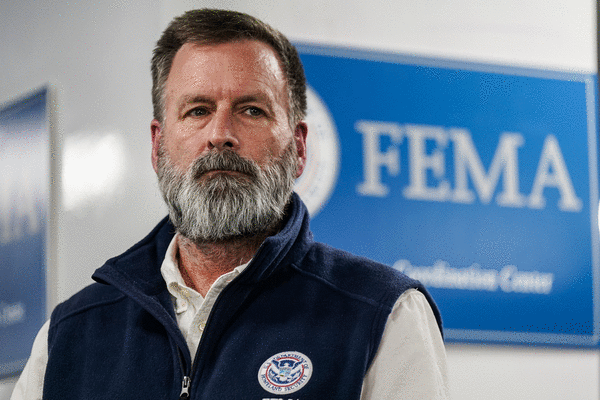
The government agency responsible for handling natural disasters is something of a disaster itself. The good news is that its prospects are marginally better today than they seemed just a few months ago. The bad news is that those prospects would still mean a federal response and preparedness body that struggles to respond to and prepare for catastrophes.
Last week, a task force convened by President Donald Trump issued a list of recommendations for reforming the Federal Emergency Management Agency. The punch list was equal parts sweeping and performative, as exemplified by the last page of its slide deck, which managed to sum up its proposals in seven squishy verbs, such as “Cultivate” and “Amplify,” that formed the acronym “AMERICA.”
The overall gist was mostly in keeping with Trump’s long-stated desire to shrink (if not obliterate) FEMA and hand over the burden of disaster response to states, towns, private companies, faith-based groups and disaster victims. FEMA, perpetually underfunded and under political duress, does need reform. But when the number of billion-dollar weather catastrophes has never been higher, the panel’s prescription is mostly the opposite of what’s needed.
“Weakening FEMA does not create resilience, it creates abandonment,” Chrishelle Palay, who lived through Hurricane Harvey and the 2024 Houston Derecho, said at a press conference arranged by Organizing Resilience, a nonprofit advocacy group.
On the plus side, the panel’s final report at least dropped a couple of the spicier recommendations of earlier drafts. For one thing, it didn’t call for a brutal 50% staff cut. It also dropped an explicit suggestion that FEMA stay part of the Department of Homeland Security. Given its importance, FEMA should be a cabinet-level agency that reports directly to the White House. The task force report leaves that door open, and there may even be bipartisan support for making it happen.
Those glimmers of hope are part of a trend of mildly better news for the agency since the defenestration of former DHS Secretary Kristi Noem. Her successor, Markwayne Mullin, ended Noem’s policy of vetting all agency spending above $100,000. That pointless bottleneck made FEMA even slower to act in emergencies than it already was.
Mullin has also brought former FEMA head Cameron Hamilton back in from the cold. A year ago, Hamilton had been the acting FEMA chief for all of three months when he committed the cardinal sin of saying his agency should continue to exist. He was ousted a day later. Now it looks as if he may soon get his old job back, possibly signaling Trump has conceded the need to at least keep FEMA around.
But that’s just about where the good news ends. Hamilton, like his wisecracking predecessor David Richardson, lacks the emergency-management training required by law. The person now in charge of FEMA’s disaster response is still conspiracy theorist Gregg Phillips, who claims he has teleported into ditches and Waffle Houses, or as we called it growing up in the South, “Friday night.”
The FEMA task force may not call for a 50% staff cut, but nor does it suggest rehiring any of the 6,000 workers the Trump administration fired last year, stretching a workforce that was already too thin by about 6,000 people, according to a 2023 Government Accountability Office report. Mullin has recently offered to rehire 200 temporary workers, whom Noem dropped in January, to help prepare for hurricane season, but that’s not nearly enough to handle FEMA’s workload.
The task force calls for turning FEMA aid to state and local governments into block grants based on parametric triggers, meaning certain wind speeds or other specific disaster measurements need to be reached before locals can get paid. Local governments will also have to prove they can’t handle the catastrophe on their own. Meanwhile, the panel also calls for making it harder for disaster victims to get help with housing.
All of this is meant to speed up the admittedly laborious process of getting relief funds to disaster areas. But it mostly raises the risk those areas won’t obtain any relief at all. If, for example, a state suffers millions of dollars in losses because of a hurricane in which top wind speeds were 99 miles per hour, but the parametric trigger is set at 100 mph, then that state theoretically won’t get any money. Less federal aid means stretched local budgets will struggle to handle not only rebuilding but steeling themselves against future disasters.
The task force also suggests reforming the National Flood Insurance Program managed by FEMA. It’s another worthy goal, but once again some of the proposed solutions solve nothing. It wisely calls for setting more realistic (meaning higher) NFIP premiums and updating flood-risk maps that are even more outdated than my teenage memories of teleporting to Waffle House. It tries to address the issue of repeated rebuilding of properties in flood-prone areas.
But it also calls for transitioning homeowners to private insurance policies, which still make up a tiny part of the market. A lack of affordable private flood insurance was the reason Congress created the NFIP in 1968 in the first place, and flood risks are astronomically higher today than they were in Lyndon Johnson’s time. Hotter air holds more moisture, meaning rainstorms dump more water in downpours that overwhelm homes and infrastructure. Rising sea levels mean “nuisance” floods, which occur at high tide in the absence of disaster, are becoming routine in highly developed coastal areas.
Most of the FEMA task force’s recommendations will need either approval from a distracted Congress or new regulations. It’s probably too much to expect quick action of any kind, much less positive action. We’ll have to hope the coming hurricane season is as forgiving as the last one was, although even a simple heavy rainstorm can be a tragedy, as in Texas last year. Every time our luck is tested, FEMA’s weaknesses risk being exposed.
____
This column reflects the personal views of the author and does not necessarily reflect the opinion of the editorial board or Bloomberg LP and its owners.
Mark Gongloff is a Bloomberg Opinion editor and columnist covering climate change. He previously worked for Fortune.com, the Huffington Post and the Wall Street Journal.
©2026 Bloomberg L.P. Visit bloomberg.com/opinion. Distributed by Tribune Content Agency, LLC.









































Comments