Editorial: Alligator Alcatraz has been a shameful nightmare. Shut it down
Published in Op Eds
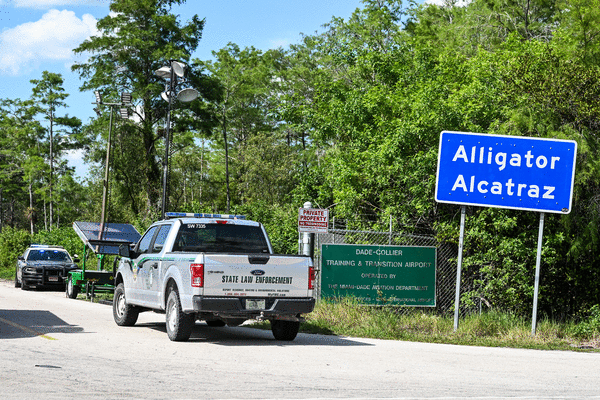
Gov. Ron DeSantis was trying to spin the news that he might have to close Alligator Alcatraz, his fetid, jerry-built concentration camp in the Everglades.
“If we shut the lights out on it tomorrow,” he said, “we will be able to say it served its purpose.”
It’s fair to ask just what that was.
It has cost Florida at least $608 million, and probably close to $1 billion by now. The Trump administration said eight months ago that it would reimburse the state’s taxpayers for the $608 million, but hasn’t sent a dime. There’s no due date on the IOU.
It is probably one of the biggest wastes of money in Florida’s history — spending that could have protected seniors vulnerable to abuse or helped families about to lose Medicaid coverage. To hear DeSantis, the purpose was to help the feds cope with a temporary housing emergency created by Donald Trump’s wholescale immigrant detentions and deportations. But that was a choice on the governor’s part, not a necessity. Immigration has been exclusively a federal responsibility since the Supreme Court so ruled in 1876.
Throughout the past 100 years, Florida has welcomed immigrants regardless of their status. Their labor was greatly appreciated by Florida’s agriculture, tourism and construction industries, the pillars of our economy.
A stunt from the start
Then DeSantis (who ran for president in 2024) decided he wanted to out-Trump Trump — tapping into a political marketplace of resentment and bigotry among Americans receptive to lies that immigrants abound with “bloodthirsty criminals” who were “poisoning the blood of America.” DeSantis’ words haven’t been as vile as Trump’s. but his methods have been as reckless and brutal. Most Floridians remember the vicious stunt that recruited immigrants in Texas and flew them to Martha’s Vineyard. He was clearly shooting for a particular visual: Wealthy, mostly Democratic Massachusetts residents reacting with scorn and alarm. He didn’t anticipate that residents of that elite resort town would instead greet the bewildered travelers with kindness and concern, or that all of them would turn out to be in this country legally, as they sought asylum from oppressive regimes or regions torn by natural disasters.
In 2023 the legislature gave him the nation’s harshest state immigration law. He compelled sheriffs and police chiefs to cooperate with ICE. Then, last year, he converted a little-used airstrip in the Everglades into a migrant prison that quickly became notorious for cruelty and for denying prisoners contacts with their lawyers and families.
“Everything about this screams inhumane and unnecessary, and the cruelty is the point,” said U.S. Rep. Debbie Wasserman Schultz, D-Weston, who spent three hours inspecting it last month. She told of finding 32 men housed in each cage, minimal food, and a persistent odor of urine.
Meant to be mean
Yes, the cruelty was the purpose. There were other places, notably the former Homestead Air Force Base in Miami-Dade County and Camp Blanding near Jacksonville, that could have been put to use if the state had any business detaining immigrants. . Both are close to population centers, with existing infrastructure. Instead, he buried it deep in the Everglades, so isolated that human waste has to be trucked away, under a $92 million no-bid contract with a St. Petersburg company artfully named “Doodie Calls.”
Suspicion lingers that DeSantis and his chief of staff at the time, James Uthmeier, chose the isolated airstrip in large part so they could label it with the catchy name of Alligator Alcatraz. Uthmeier, a notorious loose cannon, is currently filling Ashley Moody’s term after she resigned as attorney general. He’s running for election to the office in November.
But now it appears that the entire mess was too Trump, even for Trump himself. The remoteness of the place, the fiscally reckless extravagance of it and the inconvenience even to Homeland Security personnel who process the prisoners in and out: All these have been cited as reasons that the federal government is now pressuring Florida to close it.that seems to account for the federal pressure to close it.
According to DeSantis, nearly 22,000 detainees have gone through what ICE refers to as the Florida Soft-Sided Facility South. ICE says about two-thirds of them had no offenses other than being in the U.S.
Shut it down
Legally, the place exists in a nether realm. In overturning a lower court’s order to pause admissions for an environmental impact statement, a split decision of the 11th U.S. Circuit Court of Appeals in Atlanta said the law governing federal projects didn’t apply because “Florida, not federal officials constructed the facility. They control the land and ‘entirely’ built the facility at state expense.”
One judge disagreed, contending that it owed entirely to the federal government’s request for assistance.
“The evidence of federal control,” wrote Judge Nancy Abadu, “is most apparent when we acknowledge that immigration remains uniquely and exclusively within the federal government’s domain.”
In opposing an environmental impact study, the state’s own attorneys wrote that Florida “took the risk (and still does) that federal funding will not materialize.”
The risk was to Florida’s environment as well as to its treasury, not to mention its checkered reputation for how it treats people.
The airstrip was intended in the 1960s for a massive jetport that, with its access corridors east and west, would have trashed Florida’s greatest natural resource, the Everglades. Public pressure put a stop to that in what is now regarded as the dawn of the environmental movement.
The Legislature, meeting on the overdue state budget this week, should cut off the emergency funds that DeSantis has been squandering on Alligator Alcatraz.
It is indeed time to shut the lights out, but not tomorrow: today.
____
The Orlando Sentinel Editorial Board includes Executive Editor Roger Simmons, Opinion Editor Krys Fluker and Viewpoints Editor Jay Reddick. The Sun Sentinel Editorial Board consists of Executive Editor Gretchen Day-Bryant, Editorial Page Editor Steve Bousquet, Deputy Editorial Page Editor Dan Sweeney and editorial writers Pat Beall and Martin Dyckman. Send letters to insight@orlandosentinel.com.
___
©2026 Orlando Sentinel. Visit at orlandosentinel.com. Distributed by Tribune Content Agency, LLC.













































Comments