David M. Drucker: Flipping the Senate is a real possibility. It won't be easy
Published in Op Eds
The Republican Party began this midterm election cycle as the heavy favorite to retain the Senate majority. That was still the case just 10 weeks ago, on the eve of the Iran war. Today, the prospect of the chamber’s control changing hands can’t be dismissed.
That arc would suggest the war is the problem. But it’s not that simple.
Voters were already frustrated with the high cost of living one year into President Donald Trump’s second administration, and dissatisfaction was growing with his leadership on a host of other issues — especially among independent voters, who are so influential in midterm contests. Indeed, Democrats were poised to erase the GOP’s thin majority in the House of Representatives before the U.S. went to war against Iran on Feb. 28.
What the conflict did, then, was further expose and worsen two of Trump’s core vulnerabilities: a seeming inability to tame inflation and a demonstrated lack of focus on that issue, which voters care about most.
The result? The map of Senate seats up for control this November now offers Democrats a path to the majority, even if on paper it still favors Republicans. (Democrats also maintain their edge in the battle for the House, despite a spate of stinging redistricting setbacks in Virginia and elsewhere.)
“This is going to be an economic election based on people looking at cost of living and how effective the administration has been at addressing cost of living,” David Winston, a Republican pollster who has lived through many a midterm wave, told me. “The electorate, particularly on economic issues, wants to hear you discussing what they think is the most important issue.”
Trump and congressional Republicans aren’t doing nearly enough of that, as far as voters are concerned. That’s a major problem for the GOP.
Republicans command a 53-47 seat majority in the Senate. Because the GOP wields the vice president’s tie-breaking vote, Democrats need to flip four seats to take back a majority they lost just 18 months ago. That might not sound like a heavy lift. Only a third of the Senate’s 100 seats are on the ballot every two years, however. And most states up for grabs this cycle are situated in red states or ones that usually prefer Republicans for president.
The conditions necessary for a power shift in the Senate, however, are showing signs of overwhelming Republicans’ geographic advantage. Midterm elections are typically referendums on a president’s job performance, and Trump’s overall job approval has sunk to just a hair above 40%, per the RealClearPolitics polling average. Support for the Iran war, underwater since Day One, is also abysmal, at 39.3%. And crucially, the president’s rating for his handling of inflation has cratered to 29.1%.
But how — and where — Democrats can capitalize is a matter of some dispute. The Cook Political Report with Amy Walter rates seven seats as competitive, four of which Republicans must defend. Inside Elections with Nathan L. Gonzales classifies 13 as “in play,” nine of which the GOP currently holds. RealClearPolitics rates eight Senate campaigns as “tossups,” five of which are for Republican-held seats.
The states with Senate races to watch reveal just how challenging the political environment is for the GOP.
Alaska, where Senator Dan Sullivan is running for reelection, is a red state now on alert. My Republican sources — who, to be clear, are rooting for Sullivan — tell me it’s possible he loses to Democratic former Representative Mary Peltola. Then again, the Last Frontier hasn’t sent a Democrat to the Senate since 2008, and Sullivan ousted him after one term.
“Democrats have won one Senate race in Alaska in the last 45 years, and the GOP incumbent was a convicted felon at the time of that one election,” Harry Enten, CNN’s chief polling analyst, reminded me.
Reliably red states Iowa, Ohio and Texas also feature Senate contests that are not locks for the GOP.
Purple North Carolina, which, like Alaska, last sent a Democrat to the Senate in 2008 — also for only one term — appears headed toward electing Democratic former Governor Roy Cooper to replace retiring Republican Senator Thom Tillis. And Democrats are slight favorites to defend turf in Georgia, a reddish-purple state where Senator Jon Ossoff is running for a second term.
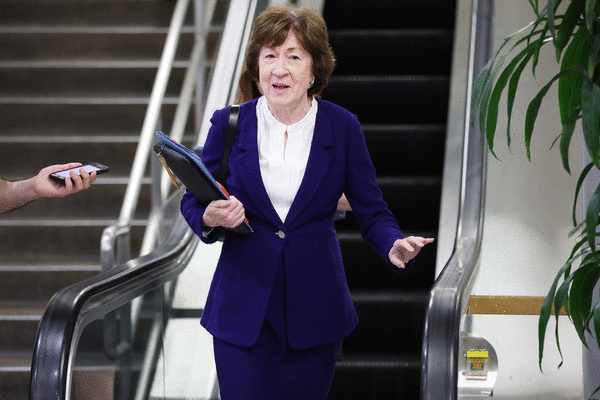
In blue Maine, Democrats are on offense, hoping to finally take down Senator Susan Collins. The battle-tested Republican, who’s been in office nearly 30 years, is set to face Graham Platner, a populist Democrat with a history of controversial statements. He’s already chased sitting Governor Janet Mills out of his party’s Senate primary.
Republicans should arguably be the favorites in every one of these states, except for Maine and North Carolina. But they’re not.
The shift has made a believer out of Senate Minority Leader Chuck Schumer. “I feel like we’re going to take back the Senate,” the New York Democrat told NOTUS’s Igor Bobic in an interview last month. “If you had to ask me last year, I would have said ‘no.’”
Precisely because Democrats are fighting on such hostile terrain, there are no guarantees. Plus, the party hasn’t nailed down its defense of an open seat in Michigan, where a divisive primary threatens to elevate a progressive, anti-Israel candidate who could swing the race to Republican former Representative Mike Rogers.
As for Democrats who believe James Talarico is the answer to their prayers in Texas, well, it’s been nearly 40 years since a Democrat won a Senate race there. (A Democrat hasn’t won any statewide race there, of any kind, since 1994.) If history is any indication, Talarico’s chances are low, even against scandal-plagued state Attorney General Ken Paxton, who’s currently challenging Senator John Cornyn in a May 26 GOP primary runoff.
Democrats clearly have major obstacles to surmount, internally and externally, and whether they’ll manage to do so is hard to predict. Republicans would, nevertheless, do well to heed the warning their previous Senate majority leader issued during Trump’s first midterm election: “The map doesn’t win elections,” Senator Mitch McConnell of Kentucky told me during the 2018 cycle. “The atmosphere is not irrelevant.”
____
This column reflects the personal views of the author and does not necessarily reflect the opinion of the editorial board or Bloomberg LP and its owners.
David M. Drucker is a columnist covering politics and policy. He is also a senior writer for The Dispatch and the author of "In Trump's Shadow: The Battle for 2024 and the Future of the GOP."
©2026 Bloomberg L.P. Visit bloomberg.com/opinion. Distributed by Tribune Content Agency, LLC.




















































Comments