The Neighborhood Newspaper: Why Your Dog Knows More Than You Do”
Published in Cats & Dogs News
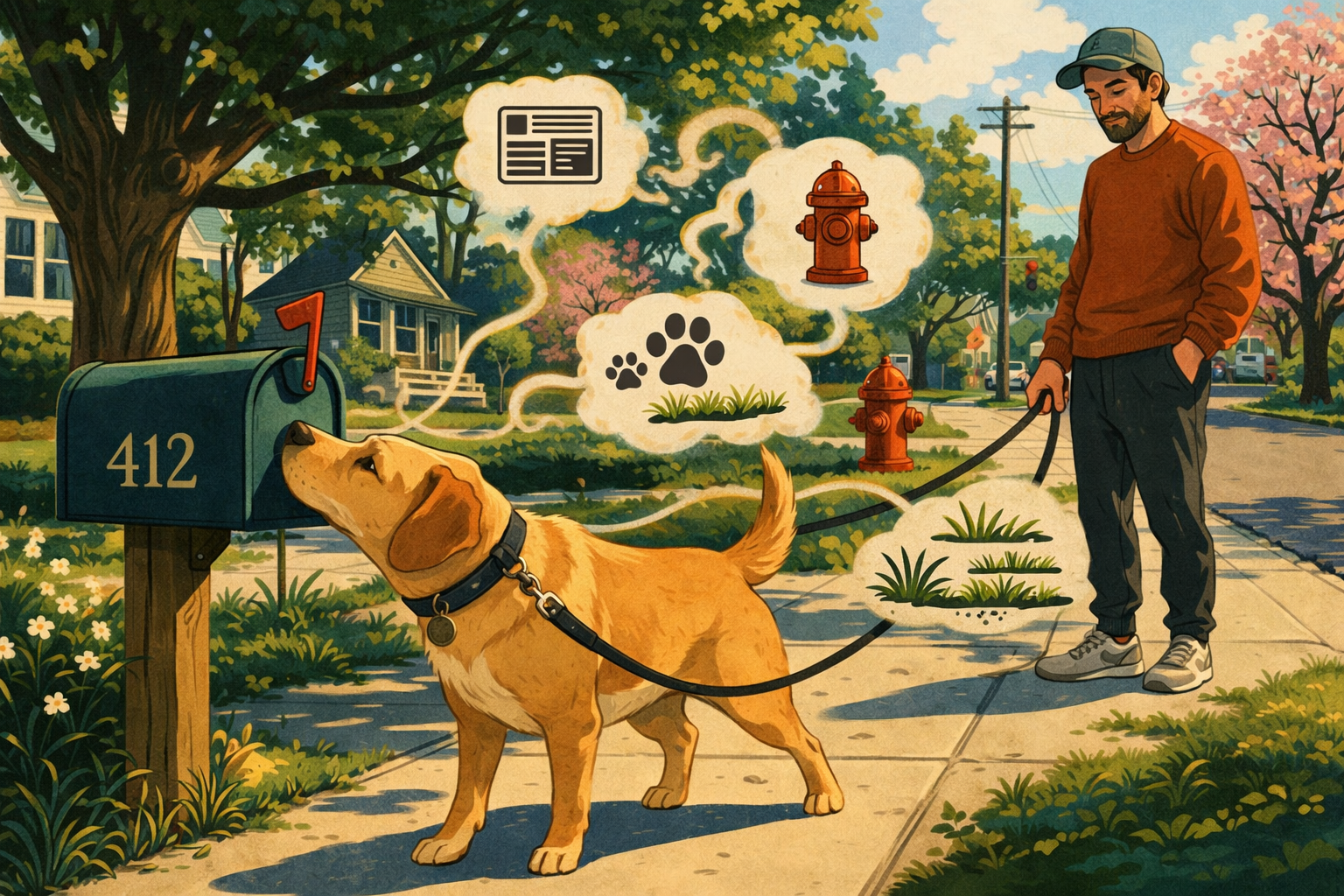
A dog pauses at the edge of a yard, nose pressed low, tail held in quiet concentration. To the human at the other end of the leash, it looks like hesitation, distraction, or stubbornness. But to the dog, it is something else entirely — a moment of reading, of gathering information, of catching up on everything that has happened since the last time they passed this way.
What appears to be aimless wandering is, in fact, a structured ritual. Every mailbox, hydrant, and blade of grass carries a record. Dogs move through the neighborhood not as tourists, but as subscribers to a daily publication written in scent, refreshed constantly, and read with absolute seriousness.
The front page: the mailbox
The mailbox is rarely just a mailbox. It is a bulletin board, a central hub where the neighborhood’s most immediate updates are posted. Dogs approach it with purpose, often slowing before they arrive, as if anticipating what they might find.
Who passed through recently? How long ago? Male or female? Confident or cautious? Healthy or unwell? These details are not vague impressions but specific, layered signals embedded in scent. A dog can distinguish not only individuals but emotional states, diet changes, and even stress levels.
To a human, the mailbox is where letters arrive. To a dog, it is where the day begins.
Owners often tug gently at the leash, urging movement. The dog resists, not out of defiance, but because leaving mid-read would be like walking away from the morning paper halfway through the headline. There is context to absorb, and context matters.
Opinion section: the hydrant
If the mailbox is the front page, the hydrant is where commentary lives. This is where dogs respond to one another, not just with presence, but with emphasis.
Some markings are quick and routine, the equivalent of a passing remark. Others are deliberate, layered, and assertive — a longer column, perhaps, or a rebuttal to something previously “published.” The height, duration, and frequency of marking all carry meaning, signaling confidence, territory, or social standing.
Dogs read these signals carefully. A confident animal may linger, adding their own contribution. A more cautious one might read and move on, choosing not to engage. The hydrant is less about raw information and more about interpretation — a place where personality reveals itself.
To the human observer, it is repetitive behavior. To the dog, it is conversation.
Breaking news: the fresh patch
Every so often, a dog stops abruptly, pulled by something invisible to the human eye. The nose lowers, the body stiffens slightly, and the world narrows to a single patch of ground. This is breaking news — something recent, immediate, and worth investigating.
A passing animal, a sudden shift, a moment that has not yet faded into the background of older scents. Dogs process these discoveries with urgency, circling, revisiting, and analyzing from multiple angles. It is not unlike reading a developing story, where each detail helps clarify what just occurred.
Humans may feel the interruption as inconvenience. The dog experiences it as relevance.
These moments reveal just how active the unseen layer of the neighborhood really is. While humans rely on sight and sound, dogs navigate a parallel world of timelines and interactions that unfold continuously, whether anyone is watching or not.
The archives: the grass line
Not every scent is urgent. Along the edges of sidewalks and the stretches of grass that line the street, older information lingers — the archives of the neighborhood newspaper.
Dogs move through these areas more slowly, less urgently, but with no less interest. These are stories from earlier in the day, or perhaps the day before. Still readable, still informative, but no longer pressing.
There is value in this slower reading. Patterns emerge. Familiar presences are confirmed. The dog builds a mental map not just of space, but of activity over time.
Humans tend to think of walks as linear — from point A to point B. Dogs experience them as layered — a blend of present moment and recent history, revisited and reinterpreted with each pass.
Editorial bias: why your dog has favorites
Any regular reader develops preferences, and dogs are no exception. Some spots are visited every time, approached with anticipation. Others are ignored entirely, passed without a glance.
This is not randomness. Dogs recognize individuals and patterns. Certain animals leave stronger, clearer signals. Some are more socially significant — dominant, familiar, or simply more active contributors to the neighborhood’s ongoing narrative.
A dog may pull insistently toward a particular tree or corner, not because of habit alone, but because that location reliably offers meaningful information. It is, in effect, a trusted source.
Humans may see stubbornness. The dog is choosing quality over convenience.
Why it matters more than you think
Understanding this hidden layer of communication reframes the daily walk. What looks like delay or distraction is, in fact, engagement. The dog is not resisting the walk — the dog is participating in it fully.
Allowing time for sniffing is not indulgence; it is enrichment. Studies in animal behavior have shown that scent work engages the canine brain deeply, reducing stress and increasing overall satisfaction. A shorter walk with opportunities to “read” can be more fulfilling than a longer, hurried route.
This also explains why some dogs seem reluctant to leave certain areas. They are not finished. The story is incomplete.
For owners, the adjustment is simple but meaningful: patience. A few extra seconds at the mailbox, a pause at the hydrant, a moment at the fresh patch. These are not wasted minutes, but essential parts of the experience.
The leash as a shared experience
In the end, the walk is a shared activity, but not a shared perception. Humans see sidewalks, houses, and passing cars. Dogs perceive a dynamic, information-rich landscape that shifts constantly with each passing hour.
Bridging that gap does not require becoming a dog, only recognizing that the dog’s priorities are valid within its own framework. The leash connects two perspectives — one visual, one olfactory — moving through the same space in entirely different ways.
The next time a dog stops and refuses to move, it may help to reconsider the moment. The dog is not being difficult. The dog is reading.
And in a neighborhood full of unseen stories, there is always one more headline worth checking.
========
Callum R. Vance is a freelance features writer focusing on everyday behavior and the hidden systems that shape it. He lives with two opinionated dogs who insist on reading everything twice. This article was written, in part, utilizing AI tools.





Comments