Runaways With a Map: How a Pack of Escaped Dogs Navigated Home in China
Published in Cats & Dogs News
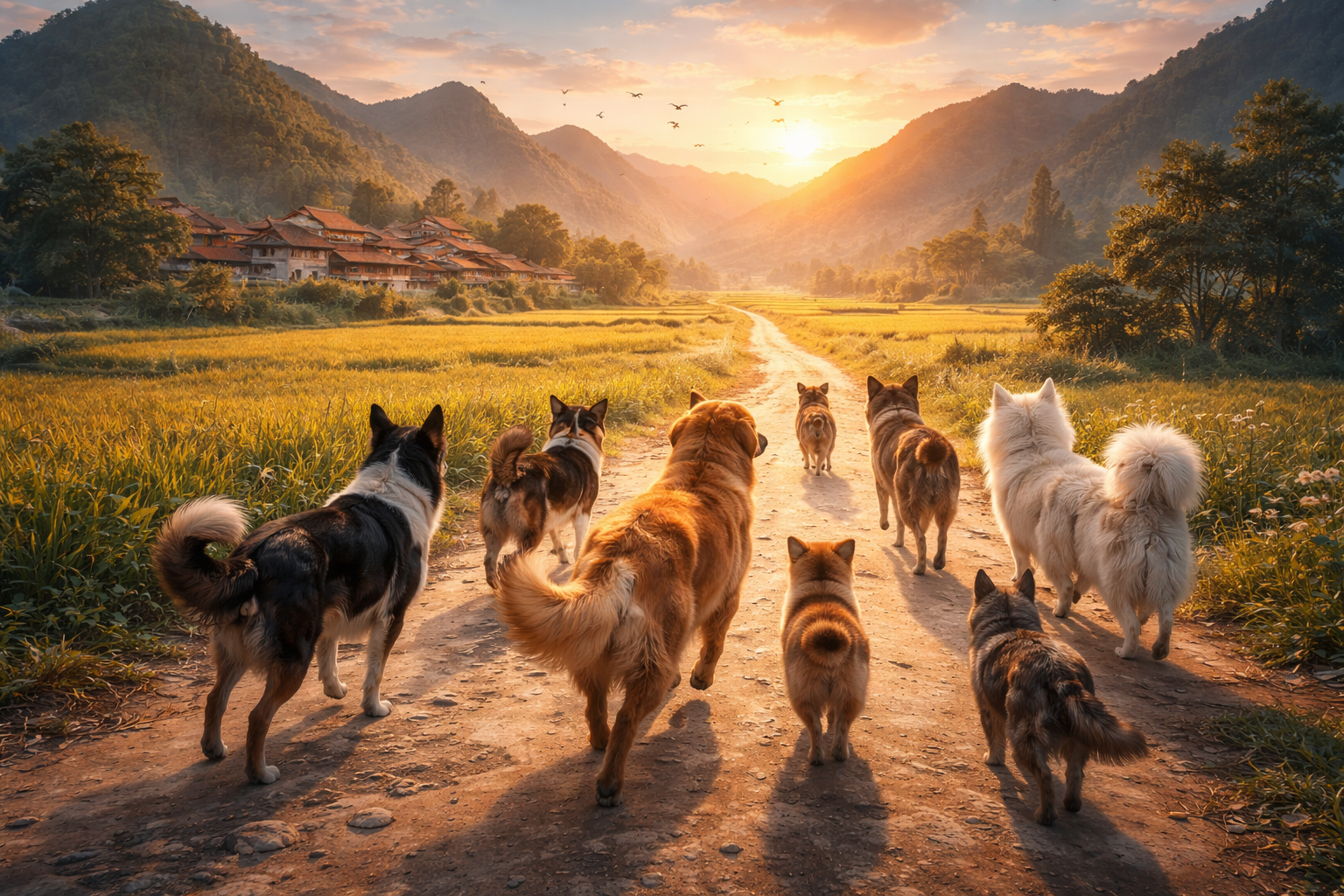
When ten dogs slipped out of a boarding facility in China, the expectation was simple: they would scatter, get lost, or require an organized search to be found. Instead, what followed has become one of those quietly remarkable animal stories that lingers in the mind. One by one, and in some cases in small groups, the dogs made their way back to familiar territory, covering distances that would challenge a human without directions. The episode has been widely shared and debated, not just because it is heartwarming, but because it raises a deeper question about what animals actually know about the world around them.
A Simple Escape, An Extraordinary Outcome
The escape itself was not particularly dramatic. The dogs, temporarily housed together, managed to get through a gate and out into the surrounding area. There was no coordinated human involvement once they were gone, and initially there was concern that the animals would disperse unpredictably. Instead, observers and later reports suggest that the dogs did not simply run in all directions. They moved with a degree of cohesion, sometimes together, sometimes splitting apart and rejoining.
Over time, reports began to come in from owners who were surprised to find their pets returning home. Some arrived tired and dirty, others seemed almost unfazed by the journey. The consistency of these returns—multiple dogs successfully navigating back—shifted the story from a simple escape to something far more intriguing. It suggested not just luck, but capability.
The Science of Finding One’s Way
Dogs returning home is not a new phenomenon, but it is still not fully understood. In this case, the scale and apparent lack of prior training make the behavior especially notable. Scientists point to several overlapping explanations, none of which alone fully account for what happened, but together form a plausible picture.
A dog’s sense of smell is the most obvious factor. With an olfactory system vastly more sensitive than that of humans, dogs can detect and remember scent cues that linger in the environment. Over time, they may build a kind of internal map based on these cues, allowing them to recognize and follow familiar pathways even after being transported away from them.
There is also emerging research suggesting that dogs may be sensitive to Earth’s magnetic field. While still an area of active study, this kind of magnetoreception could provide a broader sense of orientation, particularly over longer distances where scent alone might not be enough.
Memory plays a role as well. Even when riding in a car, dogs may retain impressions of distance, turns, and changes in terrain. These fragments of information, combined with sensory input once they are on foot, may help them reconstruct a route.
None of these mechanisms is precise in the way a GPS system is precise. But together, they may allow for a surprisingly robust form of navigation, especially in animals that are highly attuned to their surroundings.
Moving as a Group
One of the more unusual aspects of the incident is that the dogs did not behave entirely as individuals. Accounts suggest that they traveled in loose groupings, separating and rejoining as they went. This raises the possibility that their success was not purely individual, but collective.
Dogs are social animals, and even those that are not raised together can form temporary bonds under certain conditions. In a situation of uncertainty, moving together may provide both comfort and practical advantage. It is possible that one or more dogs had stronger familiarity with the route, while others followed, reinforcing the direction of travel. As the group moved, it may have corrected itself, adjusting course based on shared cues and instincts.
This kind of distributed decision-making is more commonly associated with wild animals, but it appears that domestic dogs retain at least some of this capacity. In this case, it may have increased the odds that multiple animals would find their way back rather than becoming lost.
What “Home” Means to a Dog
Beyond the mechanics of navigation, the story invites a more human question: what draws a dog back home? It is tempting to frame the behavior in terms of loyalty, but the reality is likely more complex.
Home, for a dog, is a convergence of familiar scents, routines, and associations. It is where food is found, where social bonds are strongest, and where the environment is predictable. When displaced, a dog may be motivated not by abstract attachment, but by a powerful combination of memory and instinct that pulls it toward that known space.
The fact that multiple dogs in this case undertook that journey suggests that this pull is both strong and widely shared. It is not limited to specially trained animals or particular breeds. It appears to be a general capacity, one that becomes visible only under unusual circumstances.
A Story That Resonates
The public response to the incident has been immediate and enthusiastic. People are drawn to stories that reaffirm a sense of connection with animals, and this one does so in a particularly vivid way. There is something compelling about the idea that, even in a complex and often disorienting world, a group of dogs can orient themselves and return to where they belong.
At the same time, the story has prompted quieter reflection. It challenges assumptions about the limits of animal cognition and highlights how much remains unknown. For all the advances in understanding animal behavior, moments like this suggest that there are still gaps between what we observe and what we can fully explain.
More Than a Viral Moment
It would be easy to dismiss the episode as a charming anomaly, the kind of story that briefly captures attention before fading. But it carries a more lasting implication. It suggests that the abilities of domestic animals, shaped by both evolution and lived experience, may be more sophisticated than we tend to recognize in everyday life.
For the owners who saw their dogs return, the experience was immediate and personal. For everyone else, it serves as a reminder that intelligence and perception are not confined to human terms. Sometimes they reveal themselves in quiet, unexpected ways, like a group of animals finding their way home without a map.
========
Bylin Hartwell is a freelance features writer covering science, culture and the intersections between them. He has written extensively on human-animal relationships and emerging research in cognition. This article was written, in part, utilizing AI tools.







Comments