Minneapolis mayor proposes millions in cuts, over 100 job cuts and 11.3% property tax increase
Published in News & Features
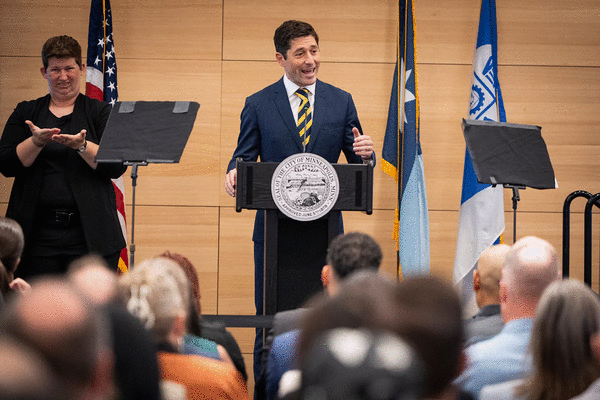
MINNEAPOLIS — Mayor Jacob Frey proposed a $2.3 billion budget Wednesday that would require a 11.3% increase in the city’s property tax levy, the elimination of 100 positions and the consolidation of several departments.
That would be the biggest levy increase since at least 2000, according to city records. But Frey said the city spending is outpacing revenue, and one-time fixes won’t fix this structural imbalance.
“Recurring expenses and budgetary amendments have too often been covered by one-time funding, vacancy savings, accounting workarounds or by simply hoping that the next year would be easier,” Frey said in a budget address. “Those approaches may appear to balance a budget on paper. They don’t solve underlying challenges.”
The tax increase means the owner of a median-valued Minneapolis home, worth $351,400, will pay $409 more a year. The property tax levy has gone up an average of 7.7% a year since 2018.
Frey’s budget address is just the starting point for months of public hearings and negotiations before final passage of a budget in December. Council President Elliott Payne said he’s not sure substantial job cuts and a hefty levy increase is the “right balance,” but he’d like to avoid another budget veto.
Council Member Jason Chavez said the council is sure to hear from the community as to whether such a big increase is merited or not.
“I think if folks feel like they are getting the services that they need and deserve, they will be OK with whatever levy is proposed,” he said.
Council Member LaTrisha Vetaw said of Frey’s proposed levy increase, “I gotta take that back to north Minneapolis. It’s double digits. It’s always shocking when folks are living paycheck to paycheck, barely making it, and you have to put out a number like that.”
Council Member Aisha Chughtai, who chairs the Budget Committee, said the city needs to rein in “reckless spending” by police.
“The Minneapolis Police Department is defunding our city,” she said.
The cuts are needed to close a $32 million budget gap driven by increasing personnel costs and flat or declining revenue. Frey’s proposed general fund budget, which pays for most daily operations, is $753 million.
Frey said the city is seeing promising economic signs so far this year in downtown vacancies, major events in the city and rising property valuations.
“Municipal finance doesn’t move at the same pace as the private economy,” he said. “The property taxes and property values that shape today’s budget largely reflect market conditions from 2024 – the low point.”
Here are top takeaways from Frey’s budget proposal:
After George Floyd was killed by police in 2020, the city quickly ramped up alternatives to police programs, including hiring community groups to try to prevent violence.
One of the most high-profile programs is the “violence interrupters,” most of them nonprofits that hire former gang members to try to diffuse tension before it explodes into violence. The neon-T-shirted workers can sometimes be seen walking in groups downtown and in other pockets of the city.
The Neighborhood Safety Department analyzed its violence prevention programs, and deduced that the community ambassadors are effective, but violence interruption results are difficult to track.
Frey called it a “noble program filled with committed and talented community leaders, but clear tracking has not demonstrated the level of results taxpayers deserve.”
So Frey proposes to make the ambassadors city employees, hiring 23 at a cost of $2.3 million.
Meanwhile, the violence interruption program would be cut by over half, or $2.6 million. The remaining violence interrupters would be deployed more strategically, rather than just cover certain areas of the city.
This cut is likely to generate significant debate at the council.
The city began a hiring freeze months ago, and Frey’s proposal would eliminate 100 positions across the city, including the mayor’s office, some through eliminating vacant positions, others planned departures and others supported by grants or one-time funding no longer available.
The city has about 4,000 full-time employees. The last time the city laid off that many people was 2010, when then-Mayor R.T. Rybak grappled with declining state aid.
The Police Department wouldn’t be spared, with cuts to civilian positions. The city is required to budget for a minimum of about 731 sworn officers, even though it currently has 656 officers and is continuing to staff up.
Frey proposes to merge the Racial Equity, Inclusion, and Belonging department with human resources; merge Neighborhood and Community Relations with the Communications Department; and move Performance Management and Innovation into the Office of Public Service.
Frey is negotiating with the Minneapolis Park and Recreation Board to consolidate some work with the parks system, such as human resources, information technology and payroll. That would require the park board’s approval.
The mayor wants to more accurately budget police overtime. Last year was the seventh straight year of record overtime costs; the last time the city stayed within its overtime budget was 2018.
The city spent $4 million to $6 million annually on overtime prior to 2020 and the departure of hundreds of police officers. Since then, overtime has exploded from over $10 million in 2020 to nearly $33 million last year.
The department is projected to blow its overtime budget by nearly $23 million this year after exceeding its budget by a similar amount last year.
Frey budgeted $15.5 million MPD overtime next year, saying it’s not an optional expense, given the staffing shortage. That’s far less than MPD spent last year and so far this year, but it’s possible to stay under that amount if there are no major crimes or unprecedented federal immigration enforcement surges like happened the past year.
Frey said the city should “transparently and accurately account for the true cost of overtime in our budget.”
“For years, we’ve used the salary savings from officers we didn’t have to pay overtime costs for those we do. ”The good news is that we have less vacancy savings because we have fewer vacancies."
A more accurate overtime budget may avoid a repeat of last year, when the police chief was excoriated by the City Council for blowing his budget.
He also proposed cutting MPD recruitment in half, to $4.3 million.
Frey’s proposal does have some budget increases and new spending, including:
Personnel costs have increased. City employees have gotten big pay bumps in recent years, led by the police union, which won a historic raise of nearly 22% over three years, followed by public works with a historic 30% raise over three years and park workers with a 10.25% cost-of-living adjustment over three years, plus a $1.75 hourly bump.
Other major factors: Health insurance is going up, MPD overtime, and local sales tax revenue has plateaued.
______
©2026 The Minnesota Star Tribune. Visit startribune.com. Distributed by Tribune Content Agency, LLC





Comments