Ward Churchill, controversial former University of Colorado Boulder professor, dies
Published in News & Features
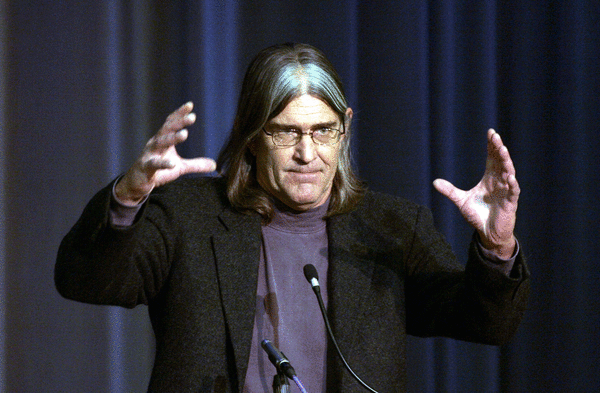
DENVER — Former University of Colorado Boulder professor Ward Churchill, a controversial symbol of academic freedom and free speech who was fired after comparing 9/11 victims to a notorious Nazi, has died, his former attorney confirmed. He was 78.
Ward died Tuesday in Atlanta of complications from a stroke, longtime friend and former attorney David Lane said Wednesday.
Churchill had been a tenured professor at the University of Colorado’s Boulder campus for more than 15 years and had served as chairman of its ethnic studies department when he was fired in 2007.
The Board of Regents said they fired Churchill for academic misconduct, alleging plagiarism and fabrication in his research on Native Americans. But Churchill sued the university for wrongful termination, claiming the real cause for his dismissal was to penalize him for an essay he had written after 9/11, in which he argued that the United States had provoked the attacks.
Churchill’s essay referred to some victims in the attack at New York’s World Trade Center as “little Eichmanns,” who were complicit in the evil of “America’s global financial empire.” The statement references Adolf Eichmann, a Nazi leader who helped orchestrate the Holocaust.
The remarks sparked national backlash, debate over free speech protections and a contentious academic-freedom battle that went all the way to the Colorado Supreme Court.
In 2009, a Denver jury found that CU unlawfully terminated Churchill for exercising his free speech and awarded him symbolic $1 in damages, but the judge did not order CU to reinstate him as a professor.
The state Court of Appeals and state Supreme Court heard Churchill’s appeals, but both upheld the lower court’s decision that the man was not entitled to reinstatement or back pay. Churchill then appealed to the U.S. Supreme Court, which refused to take the case.
“The court never said his First Amendment rights were not violated. They simply said the Regents are above the law, which is a dangerous precedent,” Lane said at the time of the decision.
Patty Limerick, a history professor at CU Boulder and proponent of academic freedom, said Churchill had a right to make those “reprehensible” statements in his 2001 essay, but they did spark the investigation into his academic conduct. One could also just as easily ask why an inquiry hadn’t happened earlier, she said.
“I think there was an enormous amount of confusion and strong feeling brought out by having it cast as an issue of academic freedom, but I don’t think it was that,” Limerick said. “I would push to say this was never about academic freedom.”
Academic freedom is important, she said, but it doesn’t protect against plagiarism. Many public officials also moved too quickly in calling for his termination, she said.
“(There’s a lesson) to be careful what you move too quickly to support, and be ready to take in more information and think maybe there’s something here we weren’t paying attention to,” Limerick said.
Lane, meanwhile, described Churchill as a passionate fighter for human rights, especially those of Native Americans and Indigenous people everywhere.
“He was absolutely fearless when it came to standing up for what he believed was right,” Lane said. “He didn’t care who criticized him; he was willing to go to jail for his beliefs. I think he was a very inspirational figure.”
Christopher Braider was part of a faculty group who protested the university’s actions against Churchill. He objected to the university’s investigation, which he believes was the administration caving to public and political pressure from Colorado and the nation.
There’s no doubt that Churchill did cheat, plagiarize and violate scholarly ethics, Braider said. But the investigation only happened because of Churchill’s protected speech, which Braider believes was wrong.
“The university wanted to fire him, and they found a pretext through this investigation of his scholarly work,” Braider said. “They wouldn’t have investigated his scholarly work without the public outcry, and that’s what the jury found.”
“The guy may (have been) a stinker, but the university behaved very badly,” Braider continued.
Churchill was born on Oct. 2, 1947, in Urbana, Ill., to Jack LeRoy Churchill and Maralyn Lucretia Allen.
_____
©2026 MediaNews Group, Inc. Visit at denverpost.com. Distributed by Tribune Content Agency, LLC.


Comments