US expects dramatic agricultural purchases by China, Greer says
Published in News & Features
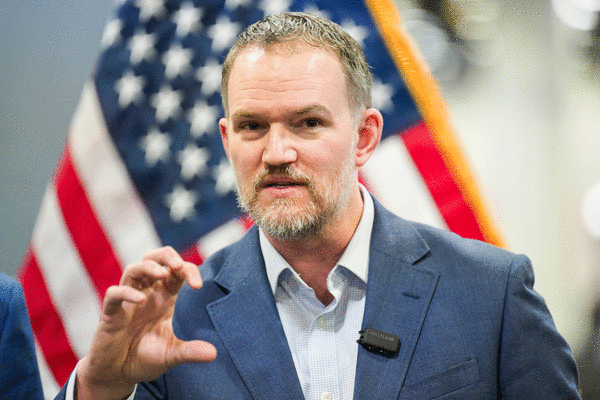
U.S. Trade Representative Jamieson Greer said he anticipates that China would commit to billions in American agricultural purchases, as Presidents Donald Trump and Xi Jinping complete their summit in Beijing.
“We expect to also see an agreement for double-digit billion purchases of ags over the next three years, per year, coming out of this visit, and that’s more general, that’s aggregate, that’s not just soybeans, that’s everything else,” Greer told Bloomberg Television in an interview on Friday.
Greer accompanied Trump on the trip, the first by an American president to China in nearly a decade and a crucial opportunity to help lessen trade disagreements between the world’s two largest economies.
The summit between Trump and Xi, China’s longtime leader, follows a truce they agreed upon last October that eased tariffs and export controls. Despite that pact, there have been persistent strains on the broader economic relationship, including over the Iran war, as the two nations weigh extending the agreement.
Heading into the meetings, U.S. officials have floated the creation of a so-called Board of Trade, casting it as a mechanism to manage commercial ties by reducing levies and trade barriers on non-critical goods that do not implicate national security concerns.
U.S. Treasury Secretary Scott Bessent said Thursday on CNBC that one idea is for each country to cut tariffs on about $30 billion worth of trade “for non-critical areas and areas that we’re not trying to reshore.”
Greer, who was also part of the delegation that Trump brought to China in 2017, downplayed Xi’s stark warning regarding over Taiwan, as reported by Chinese state media, on the first day of the summit. He suggested that the tone during the meeting might not have been as sharp.
“I don’t expect the Taiwan issue to bleed into Board of Trade. I just don’t,” Greer said in the Bloomberg Television interview. “We’ve known for a long time that the Taiwan issue is of key importance to the Chinese.”
“The Chinese know that for us, we’re interested in U.S. companies and U.S. workers being successful and leveling the playing field,” he added. “So it’s normal for different countries to have different key objectives.”
And despite the last-minute presence of Nvidia Corp.’s chief executive officer, Jensen Huang, on the trip, Greer said semiconductor export controls were not a major topic in the Xi-Trump bilateral meeting itself, although the executives did have the opportunity to address the two leaders.
While officials stressed the commitments, China has not always followed through on promised purchases in the past.
Greer said the Trump administration’s plan after the summit was to welcome public comment.
“Saying, ‘Hey, we’re trying to manage this trade with China. We want to focus on non-sensitive goods. We think we should be selling them, things we think we should be buying from them, trying to facilitate trade in that area,’” he said. “And then from there, we’ll be able to interact with our Chinese colleagues and negotiate with them over where we think we have the strongest mutually beneficial trade with our countries.”
Expectations for major breakthroughs on trade were low heading into the summit. Still, Trump was greeted with fanfare, as he arrived with a delegation of business executives, seeking to secure lower trade barriers and open market access for companies from a wide swath of industries, including finance, tech, and aerospace.
A trade clash between the U.S. and China in 2025 saw the two nations exchange escalating tariffs, rattling financial markets. Trump and Xi eventually agreed to a broad one-year truce to ease those levies. Beijing also committed to U.S. soybean purchases and relaxing export controls on critical rare earths.
____
(With assistance from John Harney and Romy Varghese.)
©2026 Bloomberg L.P. Visit bloomberg.com. Distributed by Tribune Content Agency, LLC.






Comments