Boston Mayor Wu tries to quell rebellion, as City Council mobilizes to reject her $4.9 billion budget because of cuts
Published in News & Features
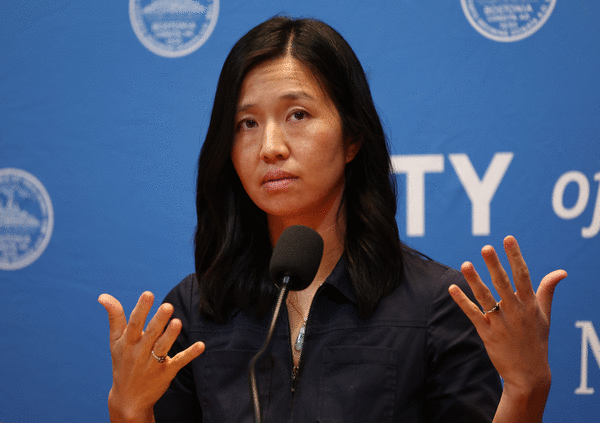
BOSTON — Boston Mayor Michelle Wu took action to try to tamp down a revolt after learning that “some” councilors were mobilizing to vote against her $4.9 billion budget and seek additional funding to prevent painful cuts.
Wu sent a rebuke to councilors in a Thursday letter, saying that a vote to reject her proposed budget for next fiscal year, which begins July 1, would be “fiscally irresponsible.” She also said she would not be increasing her spending plan.
“Some councilors have … expressed a hope that rejecting the budget would result in the administration resubmitting the budget with higher revenue assumptions to allow for increased spending,” Wu wrote the City Council. “To clarify on this point: the proposed FY27 budget represents the maximum revenue that can be responsibly budgeted for the upcoming fiscal year.”
Wu said that if the Council were to reject her budget, it may force her to put forward a reduced spending plan, because of lower state aid figures included in the House and Senate budgets, compared to what Gov. Maura Healey proposed.
“Increasing the bottom line of the budget by either inflating revenue projections or drawing from the city’s reserves would be fiscally irresponsible,” Wu wrote. “Adding non-recurring fund balance to support ongoing expenditures — even in smaller amounts — in lieu of making difficult tradeoffs threatens our long-term fiscal sustainability and creates structural problems in the city’s budget.”
A simple majority of the 13-member City Council is needed to reject the mayor’s budget. City Hall chatter, coupled with the mayor’s warning letter, indicates the Council may have been close to reaching that seven-vote threshold this week.
“I am prepared to vote no on the mayor’s budget because I do not believe it adequately meets the needs of Boston residents,” Councilor Erin Murphy told The Boston Herald. “(The mayor) worked on getting this (letter) to us this morning to try to scare us … or set us straight.”
Murphy said the mayor’s letter “seems to suggest that the Council should be afraid to vote ‘no’ because it may limit our ability to offer amendments” — a process that allows councilors to move money around, but not increase the total budget.
“Our responsibility is not to protect a process — our responsibility is to fight for a budget that actually works,” Murphy said. “Using a small portion of the city’s nearly $1.8 billion reserve fund to restore urgent needs is not reckless or fiscally irresponsible.
“Funding firefighter cancer screenings, language access, youth jobs, senior programming, and veterans’ services is responsible,” Murphy added. “These are immediate, targeted, and serious needs. If the administration does not want to use reserves, then it should identify other savings that do not harm essential services.”
Councilor Brian Worrell said he’s hearing concerns about “almost every cut” in the mayor’s budget.
“We’ve heard from a countless amount of communities who have voiced their concerns about the cuts,” Worrell told the Herald. “These were cuts that the Council has fought for over the last four to five years, so we’re unraveling a lot of the Council’s work in one budget season.”
Worrell said he’s not swayed by the mayor’s rationale that the city doesn’t have the revenue to absorb some of the proposed cuts. He said the mayor’s team has previously forecasted $70 million more in revenue for next fiscal year than what they have proposed in the FY27 budget.
“We just want to dive into the data and understand what’s going on, and have a better understanding and more clarity around expenditures and revenue while we decide what should be the Council’s next step,” Worrell said. “This budget growth, at 2%, is the lowest since the Great Recession. What would cause the city’s revenue to slow to a snail’s pace?”
Wu warned councilors that “inflating revenue projections would likely result in a mid-year budget shortfall in FY27.” She said she has decided to dip into the city’s reserve fund to close the $48.4 million deficit for FY26, and plans to file a supplemental budget with the Council next week.
The mayor said it’s “city policy” not to use reserves unless intended for “extraordinary and non-recurring events.”
Ben Weber, chair of the Ways and Means committee that oversees the Council budget process, said there’s “a lot of painful cuts” in the mayor’s budget. He said he’s reviewing Wu’s letter and talking to his colleagues to try “to figure out what the best way forward is.”
“I do think that there is a tendency in politics to want to provide immediate relief for folks, even if it mortgages the future,” Weber told the Herald. “I want to make sure that we’re not doing things that make it harder for Boston to succeed in the future, and that would include ruining our bond rating, spending down reserves and hurting Boston’s ability to react to emergencies in the future.”
Weber said he had no immediate plans to call for a budget vote, and expressed concerns that a down-vote would lead to a reduced spending plan with deeper cuts.
“I think we need to find a good reason to reject,” Weber added. “I have serious concerns about simply asking the mayor to artificially inflate revenue or spend from the reserves, but I’m still doing my research. … I think everything’s on the table, but the options we choose have to benefit Bostonians.”
Councilor Ed Flynn said he’s undecided on how he plans to vote, but takes issue with the mayor “proposing to balance the budget on the backs of veterans, seniors, educators, students with disabilities, and first responders.” He pointed to the “significant increase in personnel at City Hall” as evidence of the city’s spending problem.
“I think we have to acknowledge the wasteful spending and lack of fiscal oversight and overspending over the last several years,” Flynn told the Herald. “This has placed Boston in a very difficult financial position. … I believe during these challenging times, we must demonstrate fiscal discipline, fiscal responsibility, accountability and transparency. Raising taxes is not the answer to our struggling economy. It’s time for positive leadership.”
©2026 MediaNews Group, Inc. Visit at bostonherald.com. Distributed by Tribune Content Agency, LLC.






Comments