Dennis Anderson: Hunters will have a chance to weigh in on waterfowl management at Minnesota Duck Summit
Published in Outdoors
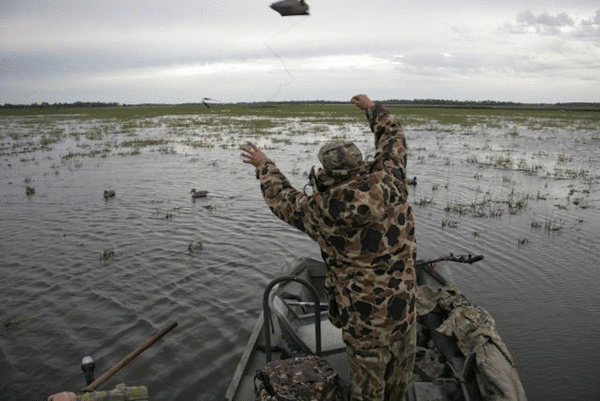
MINNEAPOLIS — Ding Darling didn’t worry about being heard when the topic was waterfowl management. To stress the importance of conservation, the two-time Pulitzer Prize-winning editorial cartoonist simply sketched an image — and another and another — lampooning Washington bigwigs when he thought their regulations were hurting ducks and duck hunting.
Darling — his given name was Jay Norwood Darling — was most famously employed by the Des Moines Register early last century. He drew, and wrote, about many topics. But conservation was his passion. When the Migratory Bird Hunting Stamp Act was passed in 1934, requiring waterfowl hunters for the first time to buy a federal duck stamp, Darling was picked to design the initial edition.
Later, Darling was named director of the Bureau of Biological Survey, forerunner to the U.S. Fish and Wildlife Service (FWS).
Like Darling, Minnesota hunters will soon be able to voice their opinions about waterfowl management, at the Minnesota Duck Summit March 27-28 in Nicollet, Minn., near the shores of historic Swan Lake.
But they won’t use pen and ink.
Instead, they’ll simply punch a few keys on their phones to answer questions such as, “Do you think Minnesota’s hen mallard limit should be reduced from two to one?” and “Do you think the state’s duck opener should be returned to the Saturday nearest Oct. 1?”
Using their phones, the hundreds of Minnesota duck hunters who will gather in Nicollet can tell state and federal duck managers instantly their opinions about waterfowl management.
The polling-by-phone idea is the brainchild of Brian Myres of St. Cloud, who is helping to organize the summit and who will administer opinion-taking at the event.
“Those of us who are organizing the summit have our ideas about duck management,” he said. “But we want to hear what other duck hunters are saying, including what they’re seeing, or not seeing, when they hunt. The summit gives us an excellent opportunity to gauge these opinions.”
Organized by duck hunters for duck hunters, the summit isn’t intended to be a gripe session — though state waterfowlers have done plenty of that in recent years. Its goal instead is to give information and, ultimately, voice to the state’s 55,000 waterfowlers, a hardy group whose numbers once breached 130,000 but have dwindled along with duck populations.
Demographically, summit organizers run the gamut. Plenty of regular-guy hunters are included among the 35 or so planners. So are nationally recognized conservationists such as Dave Zentner of Duluth, past U.S. president of the Izaak Walton League. Onetime Minnesota Waterfowl Association president Jim Cox of Cologne, Minn., chairs the Minnesota Duck Summit. Retired Department of Natural Resources and FWS waterfowl managers who couldn’t speak frankly about duck management when they were employed are pitching in, too.
The latter include former DNR staffers Ross Hier, Dave Rave, Ray Norgaard and Fred Bengston, along with retired FWS wildlife managers Scott Glup and Tony Rondeau.
Present-day DNR and FWS waterfowl managers also will be on hand to give their opinions. Representatives of Ducks Unlimited, Delta Waterfowl, Pheasants Forever, the Lessard Sams Outdoor Heritage Council and the Minnesota Board of Water and Soil Resources also will speak.
Duck management is complicated, and everyone understands that. Agricultural drainage is a problem. So are predators. So are the common carp that infest many of the state’s wetlands and shallow lakes.
Additionally, unlike pheasants, deer and other resident species, ducks are a shared resource, with each of the Mississippi Flyway’s 14 states demanding their piece of the action — and maybe a tad more.
As a primary duck production state, Minnesota is unique in the flyway. Especially now, summit organizers believe, with duck numbers declining, Minnesota should again limit opening day shooting to 9 a.m. or later, in part to give hunters enough daylight to distinguish hen from drake mallards.
Until 2011, when Minnesota duck-opener shooting hours and other regulations were liberalized to give waterfowlers more “opportunity,” that’s how hunters in the state were managed.
Now, opening day shooting begins one-half hour before sunrise. And instead of duck hunting beginning on or about Oct. 1, some form of waterfowling begins in early September and extends throughout the month.
The result: Ducks and duck hunters continue to decline.
Summit organizers — I’m one— believe there’s a better way. We think the state’s duck hunting regulations should be tweaked so that the state’s ducks are better protected, while simultaneously allowing for more satisfying, and perhaps more productive, hunting.
“We think Minnesota’s hunting regulations should be more aligned with current duck populations,” said Cox, the summit chair. “We think by ending September duck hunting, including the early teal season, over-water hunting in the early goose season, the Youth Waterfowl Weekend and the early regular opener, the state would conserve more ducks, while also providing better and more productive duck hunting when the season begins about Oct. 1.”
Other duck management ideas that will be polled include closing hunting at 4 p.m. statewide until MEA Weekend to offer resting areas for ducks, and returning the wood duck limit to two daily from three.
Habitat is of course the biggest issue facing ducks. And Minnesota’s top habitat providers — DNR, FWS and Ducks Unlimited, among others — will showcase their worthy efforts. But this question will also be asked: If the state is spending millions of dollars annually for wetland and shallow lake habitat, why isn’t that habitat producing ducks?
For summit tickets, and for tickets to a dinner and social at the Nicollet Conservation Club on Friday night, March 27, go to the Fergus Falls Fish and Game Club website.
See you there.
Bring your phone.
©2026 The Minnesota Star Tribune. Visit startribune.com. Distributed by Tribune Content Agency, LLC






Comments