LA reaches deal on cost recovery for 2028 Olympics, amid warnings about financial risk
Published in Olympics
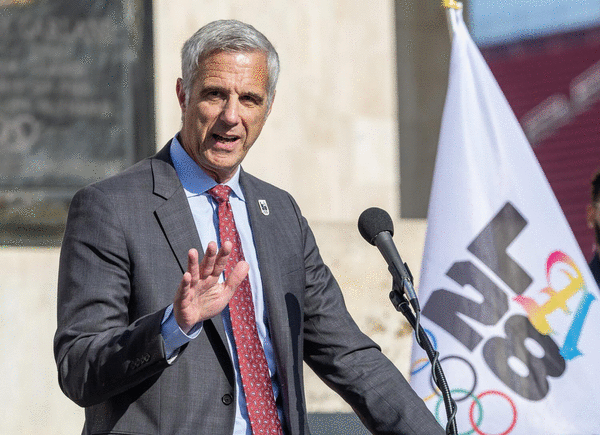
LOS ANGELES — A divided Los Angeles City Council finalized a deal with organizers of the 2028 Summer Olympic Games aimed at controlling the city's costs during the global event, amid complaints that the protections don't go far enough.
On a 10-4 vote, the council approved the Enhanced City Resources Master Agreement, which lays out the process for the city to seek reimbursement for the services it provides during the Games.
City Administrative Officer Matt Szabo said the agreement sets up additional financial safeguards, by allowing the city to tap a $270-million contingency fund set up by LA28, the privately run Olympic organizing committee, if outstanding costs remain.
Still, some on the council warned that taxpayers could wind up on the hook for $1 billion in police and other public safety costs if LA28 incurs serious losses.
"This fails to provide any safeguards for Los Angeles taxpayers and most assuredly risks the city's fiscal stability," Councilmember Monica Rodriguez said after voting against the agreement. Councilmembers Eunisses Hernandez, Ysabel Jurado and Nithya Raman, who is running against Mayor Karen Bass, also were opposed.
Critics of the Games have long voiced concern about the risks that surround the event.
If LA28 incurs massive financial losses, the city would cover the first $270 million. The state would absorb the next $270 million. After that, the city's general fund, which pays for basic services, would cover any remaining shortfall.
The city's negotiating team said L.A.'s political leaders committed the city roughly a decade ago to serve as a financial backstop for the Games, as part of the contract that made L.A. the host city.
"We are providing you today as many protections as we can, given the reality that if it is not financially successful, it does fall onto us," Szabo said. "So there is nothing we could propose today or tomorrow or next year that would eliminate that risk."
The council, in a flurry of votes, sidelined proposals from Councilmembers Imelda Padilla, Hernandez and Raman that were billed as a way to reduce the risk facing the city.
LA28 spokesperson Jacie Prieto Lopez, in a statement, said the newly approved agreement delivers on the committee's commitment to "execute a safe, secure and fiscally responsible Games that benefit Los Angeles for decades to come."
Under the terms approved by the council, LA28 would pay the city ahead of the Games for services that are ineligible for reimbursement from the federal government, such as street sweeping and deployment of traffic officers.
The terms around police protection are more complicated.
The city would first seek reimbursement from the federal government for law enforcement services, particularly in high-security zones, Szabo said. If the government fails to cover the cost of security in those areas, the city would seek all or a portion of LA28's contingency funds to make up difference, he said.
Last year, President Trump signed the One Big Beautiful Bill Act, setting aside $1 billion for state and local governments for security, planning and other costs associated with the Games.
Some council members have voiced concerns that the federal government might not follow through on its commitment, or that only a fraction of those funds would make their way to L.A., one of several Southern California communities slated to host Olympic competitions.
In April, Rodriguez sent LA28 a letter warning the city's public safety costs could easily blow past $1 billion if there is an emergency or major weather event.
City Controller Kenneth Mejia, in an interview, said he intends to use his office to look into LA28's finances in the run-up to the Games. He also argued that the deal to secure the Olympics was a bad one from the beginning.
"We're already locked into a huge financial liability. This was one of our big chances to throw in protections for the city and also provide that transparency," said Mejia, who opposed the agreement.
If LA28 makes money on the Games, the organizing committee would be barred from distributing that surplus to any organization until it has covered its financial obligations to the city, according to the terms approved Wednesday by the council.
Szabo, appearing before the council, acknowledged that the city faces a financial risk. If LA28 does experience a financial loss, it first would tap its own $330 million contingency fund, he said.
After that, LA28 and the city would have access to a second, $270 million contingency fund set up to protect taxpayers, he said.
"Is that a likely scenario? We don't believe so," Szabo said. "Their reports thus far have suggested that they are meeting their targets on their sponsorships and on other revenues, and we want them to continue to hit their targets."
Those arguments haven't satisfied an array of activists, who urged the council to rewrite the agreement.
"LA28 has no incentive to keep the city from being forced into bankruptcy," said Chris Tyler, spokesperson for Strategic Actions for a Just Economy, a nonprofit that advocates for low-income communities in L.A.
Under a deal reached in 2021, LA28 must reimburse the city for services that go beyond what would be provided on a normal day in key parts of the city, such as Exposition Park, the Sepulveda Basin and parts of downtown L.A.
The organizing committee is obligated to create a $270 million contingency fund that can be distributed as a surplus if the Games make money or cover any losses in the event of a shortfall.
The proposal approved Wednesday calls for the five-year-old agreement to be amended to ensure that those contingency funds can be used to cover the city's costs in the event that other funds aren't available.
The city and LA28 were supposed to have a draft agreement on the cost recovery process completed by October. A draft document did not surface until June.
City negotiators now head into another round of talks with LA28 on the precise level of services needed at the Convention Center, Venice Beach, Dodger Stadium and other locations. Those venue agreements must be completed in July 2027.
Under the terms approved Wednesday, the two sides must reach an accord on the cost of those additional services by October 2027.
©2026 Los Angeles Times. Visit latimes.com. Distributed by Tribune Content Agency, LLC.






Comments