US women's hockey team routs Canada, continues dominant Olympic tournament play
Published in Olympics
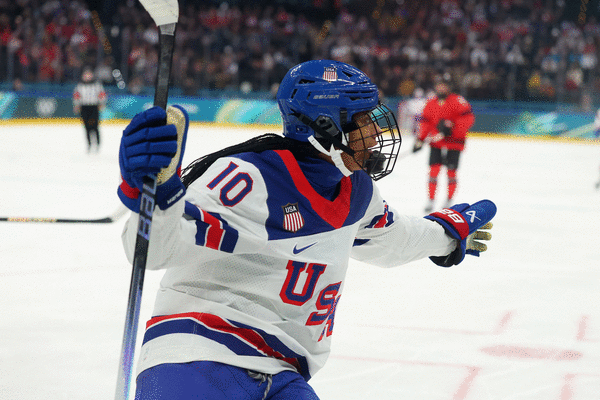
MILAN — The hockey group-play game between the U.S. and Canada at the Milan-Cortina Winter Games on Tuesday was both meaningless and vitally important.
For the record, the U.S. breezed to a 5-0 win behind two goals from Hannah Bilka, a goal and two assists from Carolina Harvey and three assists from Abbey Murphy. It was another complete, methodical performance, one that saw the U.S. score in every period for a fourth straight game while shutting out an opponent for a third straight time, running its shutout streak to 151 minutes.
But because both teams had already qualified for the next round, the only thing the result determined was positioning for the quarterfinals, with the U.S. (4-0) earning the top seed out of Group A.
Yet the game was also important because it was the U.S. and Canada, a rivalry that once stood alongside Coke-Pepsi, Dodgers-Giants and paper vs. plastic as one of the greatest ever. But is it waning?
The U.S. entered the Milan-Cortina Winter Games ranked first in the world, Canada is second. Canada has won five of the seven previous Olympic tournaments, the U.S. won the other two.
But the Americans have won seven games in a row over their northern neighbors, dating to last April’s world championships, and many of those games, such as Tuesday’s, weren’t really close.
So is it still a rivalry? Or has it become a rout?
Canada, which figures to meet the U.S. again in the knockout round, is sticking with the former.
“I don’t think you read too much into it,” Canadian captain Brianne Jenner said. “Sometimes games like that happen and it’s hard to put a finger on what it was. But I don’t think we’re lacking any inner confidence.”
The Americans, meanwhile, stayed on their best, most humble behavior afterward, trying not to poke the wounded bear.
“Every time we get to hit the ice against them, it’s an honor and a privilege,” defender Cayla Barnes said. “We have nothing but respect for them. And every time, we know it could go either way.”
Well, not lately. But Barnes said the U.S. dominance has been a process that has spanned years, not just seven games.
“This is four years in the making,” she said. “We’ve been putting together a collection of games, a collection of players, building some chemistry and a lot of trust and a lot of faith in each other. So I think that’s what you’re seeing here.
“[We] understand what we’re capable of and continue to put our foot on the gas and just play our way. There’s always something that we can get better at.”
The U.S. was on the gas from the start Tuesday, taking its earliest lead of the tournament on Harvey’s goal 3:45 into the first period. Murphy set up the next one, sending a behind-the-back pass from the end boards to the front of the net for a wide-open Bilka for the goal with less than three minutes left in the first period.
The U.S. made it 3-0 on a disputed goal 81 seconds into the second period with the referees, after a long review, ruling that Kirsten Simms had pushed the puck through a mass of bodies in the crease and across the goal line. Canadian coach Troy Ryan challenged the goal but lost, earning a bench minor for delay of game.
Bilka got her second goal a dozen minutes later before Laila Edwards closed out the scoring midway through the final period. By then Ryan had changed goaltenders, replacing Ann-Renee Desbiens with Emerance Maschmeyer, who stopped the bleeding over the final eight minutes.
For the U.S., it was a dominant performance — but one that ended with the final whistle. A different Canada, the Americans know, looms in the next round.
“We’re super hungry after this,” Canadian forward Julia Gosling said. “We’re very disappointed so we want to come out learn from it. And yeah, next time we see them, we’re going to be very prepared.”
Canada could certainly be a different team personnel-wise since it played Tuesday without its captain, Marie Philip-Poulin. She left Monday’s game with Czechia after taking a heavy hit along the boards that left her unable to put weight on her right leg. The three-time Olympic gold medalist and four-time world champion was listed as day to day.
Until that rematch, expect the U.S. to walk softly while carrying big hockey sticks. Because rivalries never truly die and this one’s not about to fade away.
“Our coaches say the same thing: never [get] too high, never [get] too low,” U.S. forward Taylor Heise said. “They’re gonna hate us even more than they already do if we end up meeting them again.”
©2026 Los Angeles Times. Visit at latimes.com. Distributed by Tribune Content Agency, LLC.






Comments