Bears have had 'minimal' talks with Illinois legislators as stadium focus remains on Hammond, Ind.
Published in Football
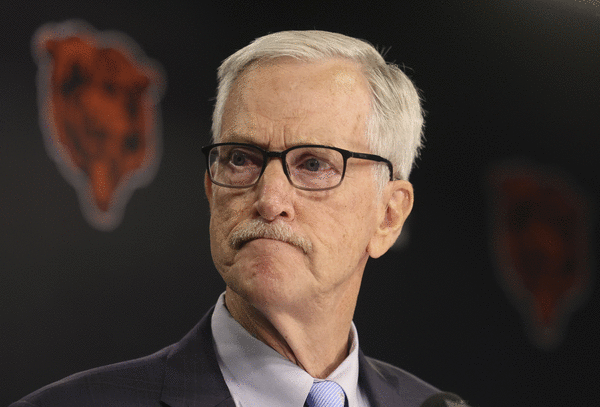
CHICAGO — The Chicago Bears have had “minimal” discussions with Illinois legislators since the NFL franchise voted in June to focus its stadium efforts on northwest Indiana.
Bears Chairman George McCaskey and President/CEO Kevin Warren reiterated Thursday during a news conference at Halas Hall that the team remains focused on building a stadium over state lines in Hammond, Ind. Those efforts have zeroed in on two sites: the Lost Marsh Golf Course and the Wolf Lake Terminals.
Warren said due diligence has been completed on the Lost Marsh location and that it is viable for construction, while the process is ongoing at nearby Wolf Lake. A merger of the two sites also is possible, Warren said.
The team’s due diligence on the sites includes topographical, geological and environmental analysis of the land, Warren said, as well as putting together a “capital stack” to finance the $2 billion the team has proposed to help build the stadium and a surrounding multi-use development.
Both Warren and McCaskey used the word “minimal” to describe ongoing communications with Illinois lawmakers this summer.
“I don’t know why it hit a dead end in Springfield,” Warren said. “But we’ve been very clear the last couple years the things that we’ve always needed is property tax certainty, we need infrastructure certainty. That’s what we’ve needed. So that has not changed.”
The Bears announced June 5 that their board of directors had voted to proceed with plans for a new stadium in Hammond. That announcement came less than a week after the Illinois legislature adjourned for the summer without coming to a resolution on last-ditch efforts in the House and Senate to keep the franchise in Illinois.
The bill that passed through the House would have allowed the Bears to negotiate a special tax payment with local government bodies in the Arlington Heights area instead of paying higher property taxes. The proposal in the Senate would have created a public finance authority, essentially establishing a public-private partnership in which a sports team such as the Bears could have built a stadium on land that would be, or would become, publicly owned to avoid property taxes on the facility.
Speaking publicly for the first time since discussions fell apart in Springfield, McCaskey said the Bears aren’t second-guessing their strategy to get a deal done in Illinois.
“We felt we had presented a pretty compelling case that a stadium in Arlington would be beneficial not only for the Village of Arlington Heights, but for the community and for the entire state really,” McCaskey said. “Tremendous driver of economic activity. Job creation. Tax revenue. Sales revenue. Ultimately, that argument was unsuccessful.”
Gov. J.B. Pritzker has said he is open to holding a special session of the Illinois General Assembly to help keep the Bears in Illinois. Pritzker said Thursday in Springfield that his office has been in contact with the Bears since the General Assembly adjourned June 1.
But in the 2 1/2 months since adjournment, the governor said the team still has “not presented a bill” to allow the Bears to build a stadium in Arlington Heights or elsewhere in Illinois.
“Part of the Bears’ job here is, of course, to talk to legislators. There were legislators who voted in favor of one or the other of the bills,” Pritzker said during a news conference to mark the start of this year’s Illinois State Fair.
“Remember, everyone, we passed a bill in the House, we passed a bill in the Senate. Those bills were not combined. …There was no compromise reached between the two bills, but the Bears themselves have to figure out which ones of the parts of those bills they want in a final bill and, of course, to gather support from the legislature.”
The stadium saga has dragged on more than five years. The Bears first announced they were bidding to purchase Arlington International Racecourse in June 2021. In that time, the team’s focus has flip-flopped from Arlington Heights to the Chicago lakefront, back to Arlington Heights and now to northwest Indiana.
McCaskey declined to elaborate on what discussions with Illinois lawmakers have looked like this summer.
“We are all adults here,” McCaskey said. “We can have constructive conversations, and I don’t think it has to be who calls who first. If there are substantive discussions to be had, let’s have them. In Indiana, they have been very proactive, very communicative, very solution-oriented.”
Indiana lawmakers have authorized spending up to $1 billion to help build the stadium, to be paid with funding from a 1% food and beverage tax in Lake and Porter counties, a 5% hotel tax in Lake County, a 12% admissions tax on events at the stadium and special tax districts around the site.
Warren also praised the “can-do attitude” of lawmakers in Indiana.
“The representatives from the state of Indiana, all the way from the governor’s office to representatives of northwest Indiana, have been phenomenal partners,” Warren said. “They’ve been stellar to work with, very professional.”
McCaskey noted that whether the Bears move to Arlington Heights or Hammond, the team won’t change its name from the Chicago Bears.
He also said he understands the anxiety that Bears fans in Illinois might feel about their team leaving the state.
“It’s going to require an adjustment,” McCaskey said. “But when I’ve driven that route, other than a sign telling me so, I wouldn’t know that I’ve just crossed the state border.
“And as Kevin said, once people see the building, once they get in there, once they understand that our top priority from day one was a world-class stadium experience, we think we’ll make that adjustment. We think Bears fans are up for that.”
Though Warren declined to provide a timeline for when the Bears want to break ground on a new stadium or when one might open — “My wife told me about six months ago, don’t give any more target dates” — he again said every year’s delay in building a new stadium costs another $150 million or so. The Bears have a lease to keep playing at Soldier Field through 2033.
While cautioning that the team must be “patient” to “get it right,” Warren emphasized the need to get the deal done.
“The time is now,” he said. “It is time to bring this to a close.”
©2026 Chicago Tribune. Visit chicagotribune.com. Distributed by Tribune Content Agency, LLC.




Comments