Commentary: Automakers' data monopoly and how they dictate car repair
Published in Auto Racing
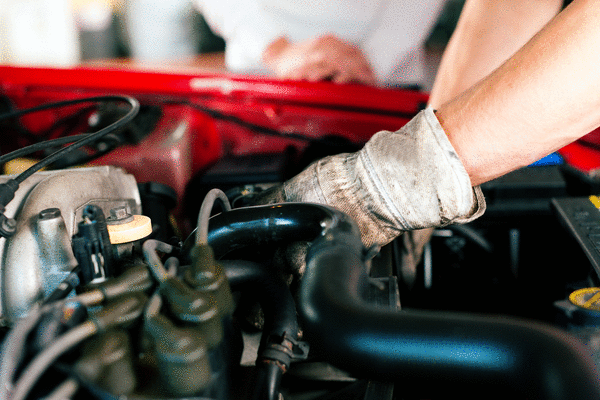
Think you own that new car you just bought? Not all of it.
As many Americans are learning, automakers own their data, and it’s trying to dictate who can fix the vehicle when something breaks or even when it just needs regular maintenance. It’s a way to force car and truck owners into expensive dealerships for service.
Fortunately, though, a legal fix might be coming.
New vehicles today rely so much on electronics and software that many repairs, even relatively simple ones, require using a proprietary computer interface or software just to diagnose an issue. Some cars and trucks even need this rigmarole to determine the optimal schedule for routine maintenance.
The results have been devastating for independent repair shops that handle most of the post-warranty automotive work across America. Almost two-thirds of these small businesses have trouble making what were previously simple repairs because of inaccessible data or software.
Over the last five years, nearly 30% of these small businesses have reported a decline in the number of vehicles they’re able to service due to this issue. Two out of every five shops have more difficulty getting parts from dealers, while one out of every four have no access to the electronic tools needed to service customers’ vehicles.
Consequently, more than half of small automotive repair businesses say they’re forced to send a customer about once a week to a dealership. The customer loses by having to pay more for the same work, and the small business loses a sale.
Today, data is a tool all its own, and this move by automakers is just a high-tech version of an old game. For years, manufacturers have played tricks like inventing and patenting fasteners — which no one else could buy. If customers and repair shops couldn’t open a product, whether a washing machine or a smartphone, then the customer’s only option was to pay whatever the manufacturer charged.
While property rights, including intellectual property, are cornerstones of America’s dynamic and innovative economy, they shouldn’t be conflated with an artificially uneven playing field. Protecting proprietary engine management software is not the same as adding the equivalent of a password to a car’s diagnostic computer.
Some automakers have erected digital walls around the data in their customers’ vehicles, treating that information like a trade secret, even though it really belongs to the person who bought the car or truck.
There has been a bipartisan push in Congress this year to address the problem via the Right to Equitable and Professional Auto Industry Repair (REPAIR) Act. The legislation would essentially distinguish between protecting innovators’ intellectual property (IP) rights and automakers’ misuse of IP law to force customers into dealership repair facilities while crushing competition.
Some industry groups argue the REPAIR Act is unnecessary because relevant vehicle data is already available through existing agreements and portals. But then why are so many independent shops having to send cars to dealers each week because they can’t access vehicle data to even make a diagnosis?
This isn’t about preserving the quality of work being done either. Independent shops can be held liable for faulty repairs just like dealers. Many states even mandate minimum warranties on common repairs, regardless of who does the work.
Arguments over the right to repair aren’t about safety but about establishing monopoly pricing power and, in the case of the automotive industry, forcing out small businesses from a highly competitive market where, historically, independent shops complete 80% of out-of-warranty repairs because dealerships are about 36% more expensive for customers.
And the problem is getting worse as vehicles become less mechanical and increasingly electronic. By 2035, 155 million vehicle owners will likely be impacted by limited choices for auto repair, increasing their average annual repair bill by about $200. That’s well over $30 billion in aggregate higher bills for vehicle owners. Rural communities, with fewer options, are hit especially hard.
While dealerships will receive a windfall, independent shops will continue losing revenue and jobs, not to mention the 4 million manufacturing jobs at risk in the aftermarket car parts industry. By 2035, the 350,000 independent businesses in that industry—the largest segment of American manufacturing—are expected to see their combined share of automotive parts sales slip from 55% to just 35%.
Competition gives American families more choices, better service and lower prices, but it requires a level playing field. In this case, that means reasonable access to repair information so that owners can decide for themselves where to have their vehicles serviced. This is about increasing competition, not concentration of power among special interests.
____
E.J. Antoni, Ph.D., is chief economist and the Richard Aster fellow at the Heritage Foundation and a senior fellow at Unleash Prosperity.
_____
©2026 Tribune Content Agency, LLC.





Comments