Shawn Fain faces 4 rivals in the UAW president race. Here's the list
Published in Automotive News
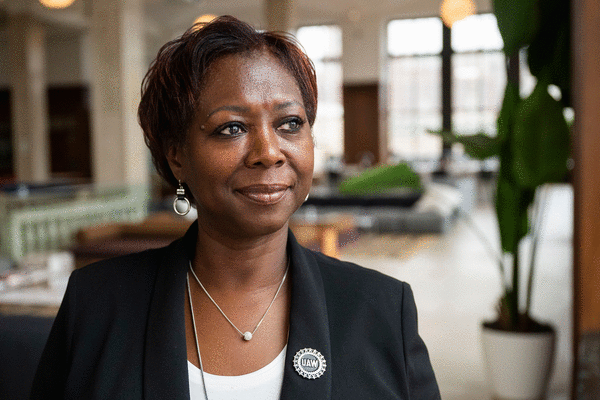
At least four United Auto Workers members plan to take on Shawn Fain to become the next president of the powerful Detroit union later this summer — and more contenders might jump in the race.
The challengers include Brian Keller, a Michigan Stellantis NV worker and vocal Fain critic with a large social media following, as well as Will Lehman, a Mack Trucks Inc. worker from Pennsylvania who favors a complete overhaul of the organization. Both men unsuccessfully ran against Fain in 2022, the first time that the union's approximately 400,000 workers and 600,000 retirees voted directly for their leadership.
Also running are Tricia Geiger, an Ohio-based UAW international servicing representative who argues the union still needs major reform, and Greg Mooney, who works at tank-maker General Dynamics Land Systems in Ohio and says the union must better prepare for job loss caused by artificial intelligence.
Fain, for his part, has assembled a group of 12 officer and regional director candidates he is running alongside called the "Stand Up Slate" — a riff on the union's "Stand Up Strike" that secured historic contracts with the Detroit Three in 2023. The group kicked off its campaign with a virtual town hall attended by almost 400 members late last month. Its pitch: keep building on Fain-led momentum of the last few years.
"We're leading the labor movement," Fain said in a phone interview with The Detroit News this week. "And while we made a lot of progress, (more) than at any time in my life, there's still a mountain of work to do.
"While we won great gains in the last contracts that we bargained in every sector, we didn't get a lot addressed on work-life balance," he said. "Job security is a big issue still with people. And then you look at the AI threats ... with AI, and technology, and advancing humanoids and things like that, we've got to rein that in. It's moving faster than what it should be at this point."
The election comes at a critical juncture for a union still trying to move past an image of corruption. It continues to be overseen by a court-appointed monitor, lawyer Neil Barofsky, whose regular reports on the union's activity have sharply criticized Fain and other union officials over concerns including retaliation, a lack of transparency and other dysfunction inside Solidarity House.
Meanwhile, the organization faces external challenges that include the Trump administration's shifting trade and labor policies, AI, its halting attempts to organize more non-union factories, and plans for the next Detroit Three contract negotiations in early 2028.
Candidates for president, secretary-treasurer, three vice president slots, and nine regional director positions continue to take shape, and some who announce their candidacy may not ultimately make the final ballots, which are expected to be mailed to members in late August and will be due by early October.
The International Executive Board candidates must secure a nomination at the union's Constitutional Convention in Detroit next month, and also survive a vetting process by the monitor.
Mock, Boyer expected to run
Several prominent candidates are still expected to jump into the race for top positions. Among them: Current Secretary-Treasurer Margaret Mock, who'd run on Fain's ticket during the last election, and confirmed she plans to seek reelection.
Fain and Mock had a falling out in 2024 that featured union leaders stripping her of key leadership responsibilities, a decision the court-appointed monitor over the union later determined was “retaliatory” and built on false accusations.
Current Vice President Rich Boyer, who'd also run on Fain's ticket in 2022, wouldn't say which position he would consider if nominated. But he indicated the need for a new direction at the top of the union, and a "desire to help make changes in the UAW that are long overdue." Multiple people inside the union believe he wants to run against Fain for president.
The union's executive board, as it did with Mock, had stripped Boyer of his leadership position heading the union's Stellantis department, but he was reinstated to the role earlier this year. An investigation by the monitor into Boyer’s situation is pending.
“Like many UAW members, I’m concerned about the direction our union has taken under the leadership of Shawn Fain and his inner circle," Boyer said in a statement to The News. "Next month’s convention will give our members the chance to begin moving their union in a better and more honest direction, a direction that puts all UAW members first. Members need a union that is open, honest and not run in the interest of those at the top in the Solidarity House."
Current Vice President Mike Booth, who leads the union's General Motors Department, also confirmed his intentions to run for reelection and said there are ongoing conversations regarding a slate of candidates that could compete with Fain's group. He said he was not asked to join the Stand Up Slate, which surprised him; Booth, like Mock and Boyer, had also campaigned alongside Fain four years ago. Booth was the only executive board member, besides Boyer, not to sign a public letter that initially refused to reinstate Mock’s leadership responsibilities following a monitor's report in June stating she had been retaliated against.
Booth said the union had made significant gains in the past few years with his leadership, from the 2023 Detroit Three contracts, to progress in the gaming sector.
“When you do your job, it takes care of your reelection,” he said. “My name is not in the monitor’s report. I want to keep it that way. No drama, no bull----, no games.”
No 'big name' to challenge Fain?
Fain has faced intense criticism both from the monitor and in some corners of the union's own membership recently; he grappled with a recall campaign that took root at several locals last year.
But Marick Masters, a management professor emeritus at Wayne State University who has long tracked the UAW, said he doesn't see anyone who can topple Fain.
"There doesn’t seem to be a big name running," Masters said. "There are rumors that some may. But if you are going to launch a major campaign against him, you’d have to be in the midst of doing that at the present time.”
He added Fain is in "as good of shape as he can be, given all the challenges he’s faced with the monitor up to this point.”
Fain downplayed criticism from the monitor, including around transparency issues inside the union, though he said the union is taking Barofsky's recommendations seriously.
He argued the union has more transparency now than it has in the past, like telling members how bargaining is progressing on Facebook Live and via other social media updates.
"Members have access to me that they've never had with presidents in the past," the 57-year-old said.
The monitor's most recent report found "significant dysfunction" with processes that govern the union's investments. It also said allegations from Fain's office against Secretary-Treasurer Mock over the investment problem had been false and retaliatory.
Fain said he and his team "don't agree on everything" in the report, but added he had been the one to raise concerns about the union's investment policy a couple of years ago.
"As a result of that, we've got back in compliance," Fain said. "We've been in compliance for quite a while, and that's a good thing."
A new political landscape
The UAW's internal politics look notably different heading into this campaign season than they did just a few years ago. The establishment Administration Caucus — founded by union icon and former president Walter Reuther — is no longer the iron fist controlling the union's leadership and direction that it was for decades.
And Unite All Workers for Democracy, or UAWD, previously a potent reform-minded group inside the union that had successfully advocated for the union's direct elections push and campaigned for Fain's first election, has since split apart amid infighting. One group still calls itself UAWD, and one UAW Member Action.
To the extent there is an establishment group of candidates running to lead the UAW, it now appears to be Fain's Stand Up Slate.
About half of the Stand Up Slate has roots in the old Administration Caucus, with several having run on the slate led by former President Ray Curry, and against Fain, in the 2022 election. They include secretary-treasurer candidate Brandon Campbell, currently a regional director, as well as Laura Dickerson, who is running for reelection to her current vice president post. The group also includes leaders who previously ran for office independently, like Region 2B Director Dave Green, and some aiming to graduate from regional positions inside the union.
Of the six candidates who had joined Fain on his Members United team of candidates in 2022, just two are running on the new Stand Up Slate. But Fain said the current group of candidates he's running with now has the experience he wants to see, regardless of their histories.
"I was elected because members wanted to change how we do things, how we bargain and how we organize," he said. "And I just look at it like, these are the people that have delivered on those priorities."
Challengers say reset needed
Keller, the Stellantis worker who ran for president four years ago, has garnered a reputation as a sharp Fain critic, including in lengthy Facebook Live sessions that he often hosts.
His platform calls for a number of internal reforms that include cutting bloat, ending "retaliation and politics of fear" under Fain, and enacting all of the monitor's reforms.
He's also advocated for improved work-life balance for workers, stronger retirement benefits, and a robust strike fund that can pay out higher wages to workers on the picket line.
Lehman, the Mack Trucks worker who also previously ran for president, said the union hasn't been aggressive enough in bargaining under Fain, and it also hasn't shown a willingness to take on the Trump administration, despite offering what he called "pseudo-left rhetoric" in recent years.
Lehman said he would seek to abolish the union's bureaucratic positions at Solidarity House, and other regional positions inside the union, and instead have workers operate the organization themselves through rank-and-file committees. Such bureaucratic roles are where the "rot" has taken hold in the union in the past, he said, and they are unnecessary.
“Workers should have complete control on their shop floor on what they want to do, as a collective," he said.
Geiger, the UAW servicing representative based in the Toledo area, said she decided to run "because I think that our members deserve leadership that’s prepared, democratic and accountable.” The union hasn’t reflected the values that it’s espoused in recent years, she said, or held itself to the same standards as it holds employers.
She'd seek to fix the UAW’s reputation and rebuild trust among its membership, pointing to the union’s past corruption scandal and the more recent monitor reports that have been critical of Fain. The union's first direct leadership elections in 2022 were an opportunity for needed reforms to take hold, she said. But “you just have to read the monitor’s reports" to see how well that's turned out.
Geiger said she'd push for stronger health care for members, as well as protections around AI, both at the bargaining table and by lobbying for stronger legislation alongside other unions. She also pledged to seek more input from UAW retirees on how the union operates and make changes to how the union's political arm supports candidates.
Mooney, who works in communications at General Dynamics' plant in Lima, Ohio, said he's centering his campaign on AI. He argues it should be the union's top focus, considering how disruptive it will be to the workforce. That means the UAW should consider retraining workers who could see their roles eliminated. The union also should be pushing for contract language that prevents employers from using AI to monitor their workers like "Big Brother."
"I think it's a bad idea to have an entire workforce or generation with no purpose in life, and that's angry, giving them basically welfare (or) universal basic income," he said. "I don't think that's going to turn out well for us."
©2026 www.detroitnews.com. Visit at detroitnews.com. Distributed by Tribune Content Agency, LLC.



Comments