Chris Jones: Who will love Chicago's old Blackstone Theatre?
Published in Entertainment News
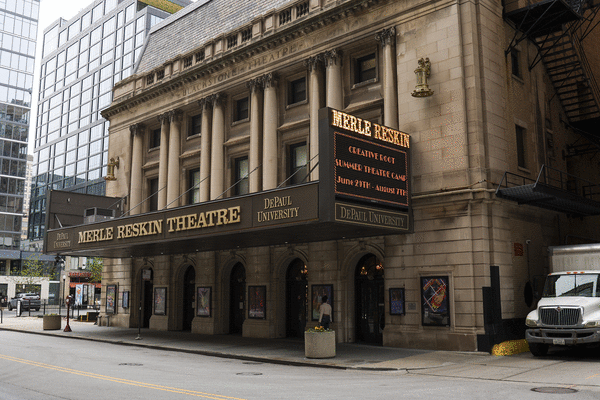
CHICAGO — “‘A Raisin in the Sun’ is a remarkable play,” Tribune critic Claudia Cassidy wrote in the winter of 1959, “acted to the Blackstone hilt of its warm heart, its proud backbone and its quicksilver funnybone by a gifted cast headed by Sidney Poitier, Claudia McNeill and Ruby Dee.”
Its “Blackstone hilt”?
The famous critic was referring to the venue, Chicago’s venerable Blackstone Theatre at 60 E. Balbo Drive, named, like the now-restored hotel next door, after a railroad executive, Timothy Blackstone. There, Lorraine Hansberry’s iconic play was performed one month before it arrived on Broadway and changed the American theater forever. “A Raisin in the Sun” had opened in Chicago with almost no tickets sold; had Cassidy not liked the show, it might never have opened on Broadway at all.
Now the fate of the Blackstone hangs in the balance, and potential suitors are not exactly falling out of the trees. The issue is not so much the building, which is protected as part of the Historic Michigan Boulevard District and can’t legally be demolished, but whether it ever will return to first-class theatrical operations. As its history so richly deserves.
Built in 1910 by the Marshall and Fox architectural firm and bought by the Shubert organization in 1948, the Beaux-Arts Blackstone was once busy with a new touring show every couple of weeks. “The Odd Couple” played there for a year from 1966-67. Bob Fosse’s “Chicago” did 11 weeks in 1978 with Jerry Orbach as Billy Flynn. Go back into the pre-Shubert days and it was a major home of the Federal Theatre Project in the 1930s and even the notorious Theatrical Syndicate. Go forward to 1988, Lily Tomlin was performing her “The Search For Signs of Intelligent Life in the Universe” on its stage.
Perhaps most tantalizing of all, no less than David Bowie appeared at the Blackstone Theatre in the summer of 1980 in “The Elephant Man,” causing something of a local media sensation as he remained in Chicago for an entire month.
After the Shuberts left the Chicago market in 1989, leaving their name on one of the Loop’s theaters (now the CIBC), the Blackstone was bought by DePaul University, which had acquired the Goodman School of Drama and needed a theater for its students, given that the school itself was housed in a former Lincoln Park Catholic elementary school. The Blackstone was renamed the Merle Reskin Theatre for a benefactor, the famously ebullient Merle Reskin, a lovable arts lover who died in 2023.
Even after the Theatre School opened a flash, new 165,000-square-foot building in 2013, complete with two well-equipped theaters, DePaul maintained the Merle Reskin, mostly to produce its Chicago Playworks educational series. But earlier this year, the university announced austerity measures — a consequence, it said, of struggles with new challenges around international enrollment, among other factors.
In early March, the DePaulia student newspaper was the first to report that the Merle Reskin was on the chopping block; Martine Kei Green-Rogers, the Theatre School’s dean, confirmed to the paper that the Theatre School would “move all operations to Lincoln Park” at the end of May, which, from the point of view of the school’s savings-seeking administration, undoubtedly made sense. The school did, after all, have a new $72 million building and was using the distant Merle Reskin only sparingly. And buildings from 1910 are expensive to run. Especially theaters.
Notwithstanding, DePaul says the fate of the Blackstone/Merle Reskin still has not yet been officially determined. A spokesman reaffirmed that Lincoln Park was now “the heart” of the theater program, as long has been the case. and also confirmed the end of productions at the Merle Reskin. The statement continued: “The Reskin has been an important part of The Theatre School’s history, but it’s time to consider what its next act should be. When an official decision has been made, we will share an announcement with our university community.”
So who might be in charge of that next act, if not DePaul?
Broadway in Chicago would be an obvious candidate, given that the operation owned by the Broadway theater owner James L. Nederlander already controls such historic venues as the Nederlander (formerly the Oriental) Theatre, the CIBC Theatre and the Cadillac Palace Theatre, and has an ongoing deal with Roosevelt University’s Auditorium Theatre. Moreover, Broadway in Chicago is known to have kicked the tires of the Merle Reskin several years ago, when DePaul was previously wondering about its utility. At the time, the company determined it would take several million dollars to bring the theater up to date as a touring house — an expense but not an excessive one when it comes to old theaters.
But in the post-COVID era, the road has been in decline with fewer shows commanding long runs and, indeed, fewer shows touring. Increased competition from states with heftier incentives for creating new productions and lower costs, and from Chicago’s several nonprofit theaters increasingly interested in making deals with Broadway producers, has meant that Broadway in Chicago no longer has any overcrowding problem at its venues. That said, a restored version of the 1,400-seat Blackstone would be a neat addition to its portfolio, ideal for plays and midsized musicals. But all I got from Broadway in Chicago, which otherwise has been outspoken about the role of culture in the Loop, was a “no comment.” Not so encouraging, but one never knows.
There are two other major theater owners on Broadway. The biggest player, of course, is the Shubert Organization, which once owned this very theater. But while executive vice-president Charles Flateman told me he appreciated my remembering that “the Blackstone was in the Shubert’s portfolio back in the day” and noted the beauty of the theater, he also said that “acquiring it is not consistent with our strategic direction at this time.”
He added: “I truly hope that Chicago finds a good steward for it!” That sounded pretty definitive.
Aside from a solo operator or someone more interested in music, that in practice leaves ATG Entertainment, formerly the Ambassador Theatre Group, which, for my money would be far and away the best owner of the theater from a Chicago theatergoer’s point of view.
Not only does ATG now own seven Broadway theaters, it already owns (and has restored) historic theaters in such markets as Boston (the Colonial) and Detroit (the Fisher), among others. It is probably the only potential owner with a pipeline of shows, often star-driven, that could fill the theater as it potentially serves as a tryout house for the New York operation.
If ATG wanted an entry into Nederlander-dominated Chicago, indisputably the nation’s second most important theater city and currently a hole in its portfolio, the Blackstone would be the way in. ATG politely acknowledged my inquiry but declined to comment. But it absolutely did not close the door.
Of course, another college could be interested. Columbia College would be an obvious choice there, given that the Merle Reskin is slap in the middle of its campus, but a spokesperson told me that was not on the cards. Columbia, after all, has its own well-documented financial problems and already has a portfolio of performance spaces.
“Columbia is not pursuing acquisition of the Merle Reskin Theatre at this time,” the college said. “The college is currently focused on optimizing its existing real estate footprint, including its dedicated theater spaces such as Getz Theatre Centre and a range of performance and rehearsal venues across our campus.”
That would, in theory, leave a nonprofit theater. After all, companies like Manhattan Theatre Club and the Roundabout Theatre have expanded into Broadway houses. In theory, a company like the Goodman Theatre could do the same. But the Blackstone largely duplicates what they already have. Steppenwolf, Chicago Shakespeare Theater and Timeline Theatre just built new Chicago theaters for themselves and it is hard to think of another extant company that would have the wherewithal and the capacity both to renovate and operate a 1,400-seat historic theater. Still, New York has 41 Broadway theaters, all full most of the time. Chicago, which once had a comparable portfolio, has about a dozen sizable theaters in its downtown core with scores of other venues in the neighborhoods.
Surely room for one more downtown.
And, when in comes to the audience’s experience, a restored Blackstone, built not as a movie palace but a live theater, would be among the very best.
So what about it, ATG Entertainment? Anyone?
———
(Chris Jones is editorial page editor, as well as chief theater critic for the Chicago Tribune.)
———
©2026 Chicago Tribune. Visit chicagotribune.com. Distributed by Tribune Content Agency, LLC.










Comments