Trump says Iran strike called off after Gulf allies appealed
Published in News & Features
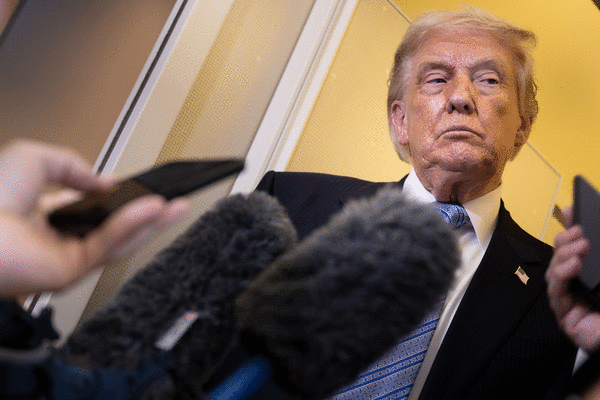
U.S. President Donald Trump said he held off on a new bombardment of Iran planned for Tuesday at the request of Saudi Arabia and other Persian Gulf allies, who are now pushing for a deal to end the war.
The U.S. delayed the strikes “for a little while, hopefully maybe forever,” because “we’ve had very big discussions with Iran, and we’ll see what they amount to,” Trump said at the White House on Monday evening.
Hours earlier, he said he was asked by the leaders of Saudi Arabia, Qatar and the United Arab Emirates to suspend plans for renewed strikes on the Islamic Republic, which Trump said were slated to go ahead on Tuesday.
Qatar said diplomatic efforts are underway to find a resolution to the conflict after Gulf leaders reached out to Trump, according to a Foreign Ministry spokesperson on Tuesday. Tehran hasn’t confirmed renewed talks.
“In their opinion, as Great Leaders and Allies, a Deal will be made, which will be very acceptable to the United States of America, as well as all Countries in the Middle East,” Trump posted on Truth Social, referring to Saudi Crown Prince Mohammed bin Salman, UAE President Sheikh Mohamed bin Zayed, and Qatari Emir Sheikh Tamim bin Hamad.
The three Gulf nations were targeted by Iranian missiles and drones between the war starting in late February and a ceasefire six weeks ago, damaging energy sites and ports.
Trump gave no details on what targets U.S. forces would have attacked or what kind of deal he would accept, beyond that it would have to include “no nuclear weapons for Iran.”
The president has repeatedly threatened renewed military action since a truce was agreed on April 8. The two sides have failed to progress to a peace deal and their forces clashed this month in the Strait of Hormuz.
The strait, one of the world’s most vital shipping chokepoints, remains all but closed, sending energy prices surging and adding to the war’s unpopularity in the U.S. Fuel pump prices in the U.S. have spiked to their highest in almost four years.
Brent crude fell around 1% on Tuesday, trading above $111 a barrel in response to Trump’s announcements late Monday. The benchmark is still up more than 50% since the war erupted with U.S.-Israeli strikes on Iran.
“These hot air verbal interventions from Trump used to have a heavy bearish impact on prices, but they now seem to have less and less effect unless they are backed by reality,” said Bjarne Schieldrop, chief commodities analyst at SEB AB. “As far as we can see there has been no real progress in the negotiations between the U.S. and Iran, with both sides still standing by their previous demands.”
Increasing energy prices led to concerns of higher inflation and slower economic growth worldwide, driving the yield on the longest-dated U.S. Treasuries to the highest level in almost two decades. Government bond yields have jumped in recent days as traders raise bets that central banks will be forced to tighten monetary policy.
The shakiness of the truce was underscored on Sunday when the UAE’s nuclear-energy plant of Barakah was hit by a drone, causing a fire at a power station and forcing engineers to switch on emergency generators.
The United Nations’ nuclear watchdog announced late Monday that normal power had been restored at Barakah, easing safety concerns over the Middle East’s biggest atomic plant.
Trump’s comments were the latest indication of the bind he’s in. Tehran’s leaders, who see the war as an existential threat, have taken a hard line. They’ve insisted the U.S. ends a blockade of Iranian ports, along with assurances they won’t be attacked again, continued control over traffic going through Hormuz and war reparations.
Iran also continues to say it will not accept any deal that completely bans it from enriching uranium, a key goal for many officials in the U.S. and Israel.
Tehran’s signaled it could again strike its Gulf neighbors if the U.S. renews its attacks. The UAE has been the most aggressive in its rhetoric and tried in vain early in the war to get the six-member Gulf Cooperation Council to coordinate strikes on Iran, Bloomberg reported. It carried out limited attacks on its own, as did Saudi Arabia, people familiar with the matter said.
Here’s more related to the war:
•U.S. Treasury Secretary Scott Bessent called on European partners to join the U.S. in action against Iran, according to his G-7 speech. He also urged the Middle East and Asia to root out Iran’s shadow banking networks.
•U.S. Central Command has redirected 88 vessels and disabled four while enforcing the blockade of the Strait of Hormuz, according to a post on X.
•Russian President Vladimir Putin is due to visit China on Tuesday and Wednesday, where he is expected to discuss the Iran war with Xi.
----------
—With assistance from Mike Cohen.
©2026 Bloomberg L.P. Visit bloomberg.com. Distributed by Tribune Content Agency, LLC.




Comments