American missionary has Ebola; US bans travel from area
Published in News & Features
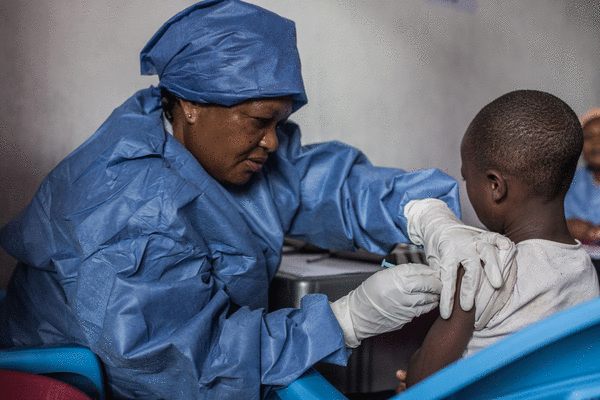
A U.S. missionary has tested positive for the Ebola virus after being exposed in the Democratic Republic of the Congo, the U.S. Centers for Disease Control and Prevention said Monday.
Satish Pillai, incident manager for the CDC’s Ebola response, said on a call with reporters that the missionary is showing symptoms and has been sent to Germany for supportive care. The CDC is also working to move to Germany six others who may have been exposed.
Serge Global, a Christian missionary organization, said on its website Monday that Peter Stafford, a doctor, was exposed to Ebola while treating patients at the Nyankunde Hospital in the Congo. The other two physicians with his group — including his wife — remain asymptomatic.
Earlier Monday, the U.S. banned non-citizens who have been in the DRC, South Sudan or Uganda within the previous three weeks from entering the country, part of an effort to protect against the deadly Ebola outbreak occurring in Africa.
The policy issued by the CDC using federal public health laws will last for the next 30 days. It includes “enhanced travel screening, entry restrictions and public health measures” to prevent the virus from entering the U.S., according to an update posted on the agency’s website.
The U.S. also paused all visa services in Uganda and the DRC on Monday. It had stopped providing travel visas to people from South Sudan under President Donald Trump’s travel ban last year.
The World Health Organization declared the outbreak a public health emergency of international concern on Sunday, citing its spread across borders, unexplained deaths, health-care worker infections and uncertainty over the true scale of the epidemic. Many countries were already monitoring dozens of passengers and their contacts from the Hondius cruise ship, where a hantavirus outbreak infected at least 10 people and killed three.
There are currently 25 CDC staff members in the DRC and all U.S. health groups designed to protect against public health threats are involved in those efforts, Pillai said. A senior technical coordinator from the CDC is headed to the region imminently, and the agency is providing other technical support remotely, he said.
The agency is looking at monoclonal antibodies that may be helpful in fighting the disease, though there is nothing approved to prevent or treat the infection, Pillai said. Any access to medicines would be provided under a treatment protocol to ensure their safe use, he added.
The WHO says the Ebola outbreak is thought to have begun in Mongbwalu, DRC, a busy mining area in a province that borders South Sudan and Uganda, and a full epidemiological investigation is under way.
The Ebola outbreak may have circulated undetected for weeks, a serious concern because it means it will be more difficult to trace and isolate people at risk and halt the virus’s spread. About 350 suspected cases and 91 deaths have been reported in the DRC, the country’s health minister Roger Kamba said on Sunday. Neighboring Uganda has confirmed two infections, including one death.
Genetic testing determined the infections stem from the rare Bundibugyo strain, one of four types that cause Ebola disease in people. There is no vaccine for it and treatment consists of supportive care. Up to 50% of infected people die from it.
The risk to the U.S. public remains low, the CDC said.
_____
(With assistance from Naomi Kresge and Jason Gale.)
_____
©2026 Bloomberg L.P. Visit bloomberg.com. Distributed by Tribune Content Agency, LLC.






Comments