Monday rush hour chaos begins in New York City as LIRR strike enters first weekday
Published in News & Features
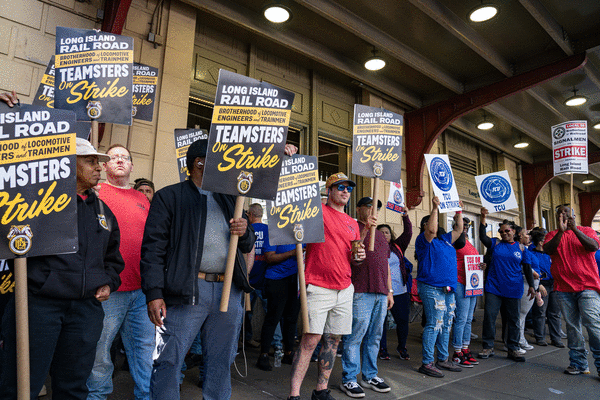
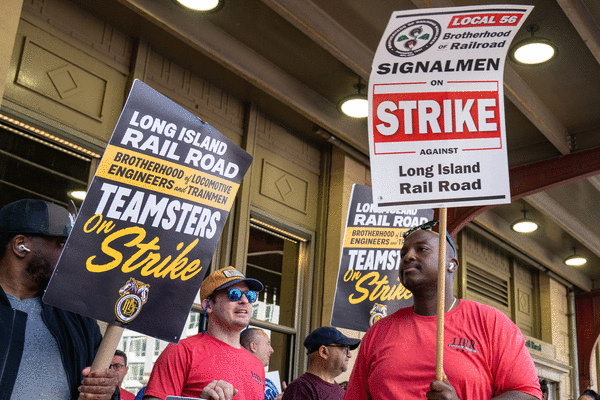


NEW YORK — Thousands of New Yorkers began a chaotic commute to work Monday as 11th-hour talks between the MTA and Long Island Rail Road workers continued.
The MTA and a consortium of unions representing 3,500 LIRR workers returned to the bargaining table at 7:30 a.m. Monday morning, following a late-night session that ran until about 1 a.m. Monday, but did not end the strike, which is now in its third day.
With no service on the nation’s busiest commuter railroad, passengers coming into Manhattan from Long Island were put on shuttle buses beginning at about 4:30 a.m.
Speaking to NBC’s Today in New York early Monday, MTA Chairman and CEO Janno Lieber said the turnout for the shuttle buses was pretty light, but admitted that rush hour wasn’t in full swing.
It appeared that most commuters, Lieber said, took Gov. Kathy Hochul’s advice to work from home, he said.
The shuttle buses will be taking Long Islanders to several transportation hubs in Queens so travelers can take New York City Transit the rest of the way to work, he said.
City subway trains, particularly at these transportation hubs, “are at capacity and running well today,” Lieber noted.
In Hillside Monday morning, a transit worker at the Jamaica – 179th Street station of the F train, one of the drop-off points for the shuttle buses, told the Daily News that the rush of waylaid commuters was busy, but not overwhelming.
One commuter, who took the shuttle from Ronkonkoma to the Hillside station, told The News his commute was smooth before beginning his second leg, taking the F into Manhattan.
Still, the MTA warned Monday that shuttle bus service was limited and could only take about 13,000 commuters to the city Monday — a small fraction of the 300,000 that use the LIRR on workdays.
“Let’s face the facts — it’s impossible to fully replace LIRR service, so effective Monday, I’m asking that regular commuters who can work from home, should. Please do so,” Hochul said Sunday.
Lieber called Sunday’s night negotiations “productive” and hoped to get the contract “over the finish line” Monday, he said.
In a statement Sunday, though, two of the unions representing the workers, the IAM Union and the Transportation Communications Union, described what they called “a disconnect between Mr. Lieber and the reality faced by workers who have gone four years without a raise.”
The unions added: “There appears to be a serious communication breakdown between Janno Lieber, MTA executives and the governor’s office about the realities of these negotiations.”
The service shutdown comes after more than two years of contract negotiations, two federal mediation boards and two weeks of talks that failed to find common ground on the one outstanding issue — raises.
The two sides settled over back pay, with a handshake agreement to retroactively raise wages by 3% for 2023, 3% for 2024, and 3.5% for 2025.
The consortium of five LIRR trade unions — made up of the Brotherhood of Locomotive Engineers and Trainmen, the International Brotherhood of Electrical Workers, the Brotherhood of Railroad Signalmen, the International Association of Machinists and Aerospace Workers, and the Transportation Communications Union — demanded a 5% raise for 2026, which they said was necessary to keep up with inflation.
After initially refusing to go above 3% without further concessions on overtime work rules, MTA leadership ultimately offered 3% plus a lump-sum payment for the difference between a 3% raise and one year of pay at 4.5%.
The unions argued that such a lump sum would only cover one year, regardless of how long a future contract took to negotiate.
Asked about the strike on Monday, Mayor Zohran Mamdani did not throw his support behind either side.
“I remain hopeful that both sides will be able to reach a fair deal for the workers that ensure that this commuter rail system actually runs, and for the riders who depend on that very same system,” Mamdani said, adding that New Yorkers should expect more congestion and longer travel times as the strike continues.
--------
—With Josephine Stratman
©2026 New York Daily News. Visit at nydailynews.com. Distributed by Tribune Content Agency, LLC.





Comments