With AI boom support, Newsom's final budget again sets California as Trump foil
Published in News & Features
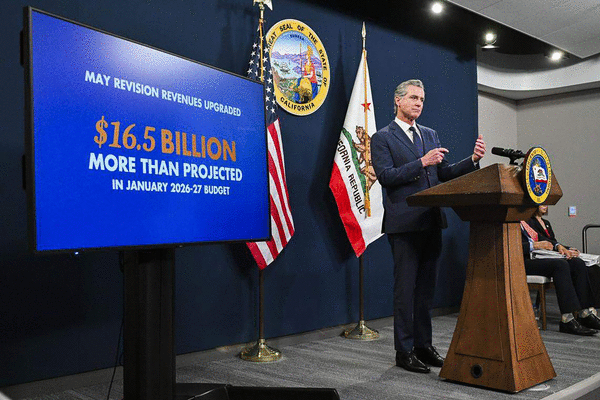
SACRAMENTO, Calif. — Touting the state’s “dominance” in industry and technological innovation, Gov. Gavin Newsom said in his final budget presentation as governor that surging revenues from the artificial intelligence industry allowed him to close the state’s budget deficit for the next two years.
Newsom said he is keeping his promise not to leave his successor with a yawning structural deficit.
“I could’ve gotten out of here with a 12-month solution, stacked up a lot of wins, not had any of these questions about any of these cuts and then really socked it to the next administration,” Newsom said.
But that stability could be fleeting, and the next governor could still find themselves without sufficient revenues to keep up the state’s heavy spending. On Tuesday, State Controller Malia Cohen warned that the state’s built-in spending growth is at a rate that could quickly become unsustainable if the state’s volatile revenue streams dropped off.
Newsom acknowledged in his Thursday letter to state lawmakers that the sudden flood of tax dollars this year could be ephemeral. Legislative fiscal analysts have cautioned that the AI industry appears to be riding a stock market bubble that could burst.
“History teaches us that prosperity, if taken for granted, can vanish as quickly as it arrives,” Newsom wrote in his letter. “California’s responsibility is to act with steady hands and anticipate future instability.”
On the other hand, the governor said upcoming public stock offerings for technology giants SpaceX, OpenAI and Anthropic are likely to bring the state a fresh infusion of capital gains tax dollars.
His budget proposes reducing general fund spending by $1.8 billion in light of those volatilities, as well as raising new revenues.
Newsom is proposing significant investments in public education, as well as new funds to bolster wildfire recovery and insulate Californians from President Donald Trump and congressional Republicans’ cuts to healthcare subsidies. Newsom also imposed three new revenue increases, including a limit to business tax credits his budget staff estimated could raise as much as $850 million this coming fiscal year and $1.8 billion the year after that.
His revenue proposals are estimated to raise $3.6 billion this coming fiscal year and $5.1 billion in the following.
For the second year in a row, Newsom used his budget presentation to position himself and the state as a foil to President Donald Trump. He spent considerable time castigating the president for damaging the global and American economy through the war in Iran, unpredictable tariff policies and other actions, describing the White House as full of economic chaos agents.
“The work of governing is not bluster and threats on social media, but preparing for storms before they arrive,” Newsom’s letter to lawmakers said.
But the governor, who has raised his national profile by mocking Trump on social media, did use his time in front of reporters on Thursday to take a number of shots at the president, with one slide featuring a meme of Trump and U.S. Treasury Secretary Scott Bessent as Dumb and Dumber and another reimagining Trump’s controversial White House ballroom proposal with a giant Newsom portrait along one wall.
Newsom’s preliminary January budget proposal kicked off an uproar from lawmakers who said the governor sought to balance the budget by paring back healthcare for the state’s immigrants, including undocumented people and those legally present in the country through humanitarian visa programs.
On Thursday, he stuck to his guns on those cuts, proposing increasing new premiums for people with unsatisfactory immigration status — undocumented immigrants, DACA recipients and other visa holders — by $20.
In doing so, Newsom reopened an ongoing fight with the Legislature. He began last year by proposing a $100 a month premium, but lawmakers wore him down to $30. Now he is proposing a $50 premium, which according to his staff would raise $427 million in the coming fiscal year but would drop to a $314 million saving the following year.
Newsom said the premiums were fair, as citizens pay Medi-Cal premiums that are often higher.
The governor also proposed instating stricter asset limits for Medi-Cal applicants — increasing the amount that assets will be included in income calculation to determine eligibility for the subsidized healthcare. That proposal could raise close to $500 million by the 2029 fiscal year, according to Newsom’s presentation.
Lawmakers opposed to such budget moves have accused Newsom of trying to balance the state’s budget by increasing costs on its most vulnerable residents.
“None of these things I want to do. I’m just trying to find some balance here,” Newsom said.
To counter cuts from the federal government, Newsom proposed a $300 million fund to insulate Californians from the expiration of Affordable Care Act tax subsidies that are spiking insurance premiums for lower income Americans.
According to a handout published Thursday morning, Newsom’s proposal “will keep $0 monthly health plans available for lower-income Californians, expand financial help so more middle- and working-class families can afford coverage, and provide new state assistance for Californians earning up to 200% of the federal poverty level.”
Surprisingly, Newsom, who has sharply opposed a proposed ballot measure to tax billionaires and generally indicated an aversion to raising taxes, proposed a limit on corporate tax credits. Under his plan, California would limit some tax credits to either $5 million or 50% of a company’s tax liability, depending on which represented a higher share of the entity’s tax bill.
He also proposed a tax on certain software sales and a tax on healthcare management companies that would raise a combined $2.8 billion this fiscal year and the next.
Two significant corporate tax proposals have gained momentum with lawmakers this year. One would collect billions of dollars more in revenue from multinational companies proponents say offshore much of their profits to avoid sales taxes in California. The other imposes a fee on mega corporations whose employees rely on Medi-Cal for health insurance.
Newsom is pairing his tax credit cap with a cut to the taxes and fees new small businesses must pay the state, according to the handout.
His budget proposal also includes a $100 million fund to provide low-interest loans for people rebuilding after wildfires when home insurance falls short.
Newsom also proposed several major public education investments. The budget proposal includes measures to put $5 billion into a discretionary block grant program that teacher training and student support, and increases special education funding by 43%, or $2.4 billion, according to the handout. There is also a $500 million investment in literacy coaches and math support staff at struggling schools.
Lawmakers began the legislative session in January with two drastically different assessments of the deficit. The Legislative Analyst’s Office predicted the state would be $18 billion short and the governor’s office predicted a $2.9 billion shortfall. The LAO built into its estimate that the state would experience a stock market downturn, the likes of which has not materialized, although the office continues to warn it is likely.
For weeks, state and legislative officials have highlighted the surging revenues, which an LAO estimate found were $25 billion higher than what Newsom had forecasted in January. Financial experts have attributed the surge to stock market enthusiasm around artificial intelligence and its related infrastructure.
Last month, the state Senate outlined their budget framework, which called for building up reserves and resisting the governor’s proposed cuts to some education, homelessness assistance and home health service programs. They also proposed delaying premiums and cuts to dental programs for undocumented immigrants.
The Assembly echoed the Senate’s reluctance to make cuts to safety net programs. But it didn’t join with the Senate in their call for a “Fair Share Contribution,” a tax on large corporations that have a high proportion of workers on Medi-Cal, California’s Medicaid.
One of the largest unknowns has been the federal government. President Donald Trump’s “One Big Beautiful Bill Act,” or House Resolution 1, signed last July, changed the rules on healthcare, altering everything from how states fund Medicaid to who qualifies for coverage. Advocates have called for the state to backfill many of the cuts.
The question of whether or not the federal government will continue to hold assistance back from California remains. On Wednesday, Vice President JD Vance announced the Trump administration would be withholding $1.3 billion in Medicaid assistance from California because of the state not doing enough to combat fraud.
Newsom’s news office said in tweets that the federal government has refused to work with the state on the issue. The state has taken action to address fraud in recent years, most recently with an action by Attorney General Rob Bonta to charge 21 people with $267 million in hospice fraud.
Bonta has had previous success suing to stop the Trump administration’s freezes to state funding. The attorney general did not immediately indicate whether he’d be taking the White House to court over the $1.3 billion Vance on Wednesday said the federal government would hold back.
The budget bill must pass before midnight June 15.
©2026 The Sacramento Bee. Visit sacbee.com. Distributed by Tribune Content Agency, LLC.






Comments