Venezuela moves to restructure debt amid economic recovery push
Published in News & Features
For years, they have stood unfinished across Venezuela like monuments to collapse: abandoned bridges rising from rivers to nowhere, rusting refineries swallowed by weeds, empty rail lines ending in concrete pillars and half-built power plants that never generated electricity.
Tens of billions of dollars disappeared into those projects during the oil boom years, even as Venezuela slid deeper into economic ruin, hyperinflation and institutional collapse. Much of the money poured into those projects is believed to have been lost to years of gross mismanagement, inflated contracts and corruption schemes involving officials tied to Venezuela’s socialist regime.
Now, after years of default and international isolation, Venezuela’s interim government says it wants to turn the page.
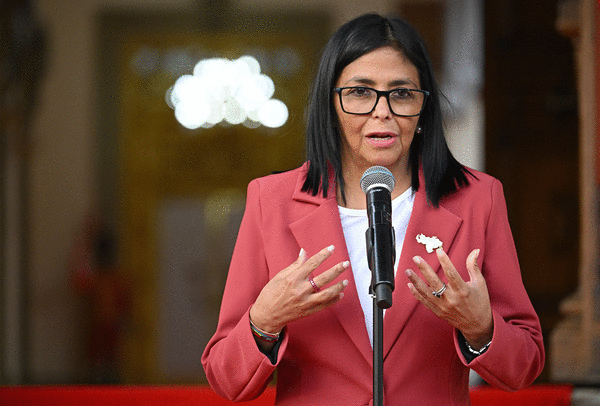
The government of interim President Delcy Rodríguez announced Wednesday that it is launching a sweeping restructuring of the country’s massive foreign debt, presenting the move as the beginning of a broader effort to rebuild Venezuela’s shattered economy following the easing of U.S. sanctions and the country’s gradual return to the international financial system.
In a statement, Venezuela’s Ministry of Economy said the government had begun a “formal, comprehensive and orderly” process to restructure both the country’s sovereign debt and obligations tied to state oil company Petróleos de Venezuela, known as PDVSA. Officials did not specify how much debt would be included in the negotiations.
According to watchdog group Transparencia Venezuela, the country’s external debt exceeds $170 billion, while independent financial think tank Official Monetary and Financial Institutions Forum has estimated Venezuela’s defaulted obligations at more than $150 billion — equivalent to more than 200% of gross domestic product.
“This is a responsible, nationalist and socially minded decision,” the ministry said. “Its objective is to rebuild the country’s capacity to mobilize financing, attract investment, stabilize the economy and materially improve the quality of life for every Venezuelan.”
Venezuela stopped making payments on much of its foreign debt in 2017 as the country spiraled into hyperinflation and deep recession under Nicolás Maduro’s socialist government.
Government officials blamed U.S. financial sanctions imposed during President Donald Trump’s first administration for cutting Venezuela off from international credit markets and preventing the country from refinancing its obligations.
“Venezuela demonstrated solvency throughout the years, fully complying with all its international obligations,” the government statement said. “This capacity and willingness to meet our financial commitments was impeded from 2017 onward as a result of financial sanctions.”
The sanctions imposed by the Trump administration in 2017 effectively severed Venezuela’s access to U.S. capital markets by prohibiting American entities from purchasing new sovereign debt or new bonds issued by PDVSA. The restrictions also blocked dividend payments from CITGO, Venezuela’s most important foreign cash-generating asset, while international banks increasingly avoided processing Venezuelan transactions for fear of violating U.S. regulations.
The restructuring effort comes amid a dramatic political and diplomatic realignment following Maduro’s capture by U.S. forces during a January operation in Caracas that triggered a transition of power and a rapid thaw in relations between Washington and Venezuela’s interim government.
After assuming the presidency, Rodríguez secured the gradual lifting of sanctions and reopened channels with international lenders that had largely frozen ties with Caracas for years.
Last month, the International Monetary Fund and the World Bank resumed formal engagement with Venezuela for the first time since 2019, paving the way for a potential IMF assessment of the Venezuelan economy and the eventual unlocking of billions of dollars in frozen financial resources.
Investor sentiment toward Venezuelan assets has improved sharply since Maduro’s removal.
The country’s benchmark sovereign bonds have nearly doubled in value since January, while PDVSA bonds surged again Wednesday following news of the restructuring initiative.
For many Venezuelans, however, the debt crisis is inseparable from the corruption and failed development projects that came to define the Hugo Chávez and Maduro eras.
The prospect of debt relief and renewed access to global financing could provide Venezuela with badly needed capital to rebuild crumbling infrastructure after years of economic deterioration and corruption scandals that left billions of dollars tied up in abandoned public works projects scattered across the country.
Independent investigations estimate that at least $40 billion to $45 billion was spent on unfinished state construction projects during the Chávez and Maduro years, though broader estimates of corruption and mismanagement are significantly higher.
Much of that spending was linked to partnerships with Brazilian construction giant Odebrecht and Chinese state-backed development funds.
Odebrecht alone received contracts for 32 major projects in Venezuela valued at roughly $40 billion beginning in 2003. Many were never completed.
Corruption allegations also engulfed PDVSA, once the engine of the Venezuelan economy.
Transparencia Venezuela estimates that more than $42 billion in public assets linked to the state oil company and its subsidiaries were compromised through corruption schemes.
The oil industry itself collapsed after years of underinvestment, political interference, sanctions and the departure of foreign companies.
Before Hugo Chávez launched his socialist revolution after taking power in 1999, Venezuela produced roughly 3 million barrels of oil per day.
Production later plunged below 400,000 barrels daily at the height of the crisis.
©2026 Miami Herald. Visit at miamiherald.com. Distributed by Tribune Content Agency, LLC.





Comments