Xi's threat to Trump cements Taiwan as top risk to US-China ties
Published in News & Features
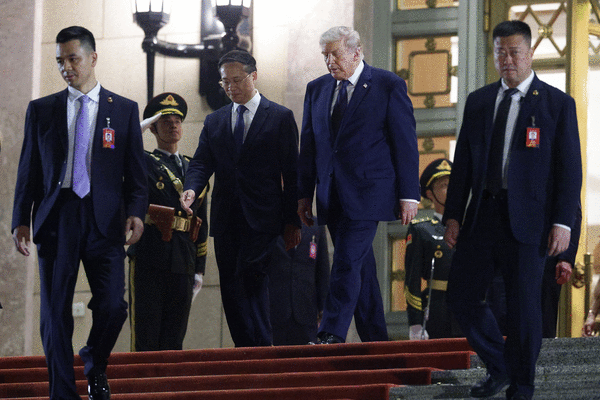
After Xi Jinping regaled Donald Trump with goose-stepping soldiers and flag-waving children, the Chinese leader’s warning that Taiwan could lead to “clashes” between the superpowers amounted to a thunderclap in the choreographed world of Communist Party politics.
Cautioning American presidents against interfering with the self-ruled island is standard practice for China. But Xi’s assertion that it could trigger a “highly dangerous situation” for the world’s biggest economies marked his bluntest language yet on the topic. Beijing’s decision to release Xi’s remarks before the nearly two-and-a-half hour huddle in Beijing had even wrapped underscored the gravity of the message.
Trump must now grapple with whether Xi will actually allow Taiwan to derail the broader relationship, particularly with the Chinese leader set to visit the White House in September — the second of four planned meetings this year. Any effort by the Republican leader to quash a planned $14 billion U.S. arms sale to Taipei would likely unleash a bipartisan backlash in Washington, at a time when he already faces voter unhappiness over the Iran war. If the deal is approved, Trump will face Beijing’s wrath.
“We want President Trump to fully understand the extreme importance of this issue for us,” said Wu Xinbo, director at Fudan University’s Center for American Studies in Shanghai, who previously advised China’s Foreign Ministry. Xi spoke out in such a “strong and direct way” to urge the U.S. to stop arms sales to Taiwan and declare that it opposes independence for the island, Wu added.
Trump and other White House officials were uncharacteristically quiet in the immediate aftermath of the warning. The president didn’t brief reporters on the outcome, with a U.S. readout hours later making no mention of Taiwan — a chip hub the Communist Party considers its own despite never having ruled it.
U.S. Secretary of State Marco Rubio told NBC that American arms sales to Taiwan “did not feature prominently” in the Trump-Xi talks.
“From our perspective, any forced change in the status quo and the situation that’s there now would be bad for both countries,” Rubio said.
For the U.S., it shouldn’t have come as a surprise. In the weeks before the summit, China dialed up pressure on Taiwanese President Lai Ching-te, whose party supports independence. Last month, Xi hosted the chairwoman of the island’s Beijing-friendly opposition party, marking the first such meeting in a decade. Weeks later, China blocked Lai’s overseas travel by pressuring three African nations to prevent his plane from safely transiting their airspace.
Xi’s strong words over Taiwan stood out during an otherwise cordial summit. The two leaders smiled as they toured the Temple of Heaven on Thursday afternoon, and reaffirmed their commitment to stable trade. Trump brought with him a delegation of 30 corporate executives — including well-known figures like Elon Musk, Tim Cook, and Jensen Huang — with the intention of securing greater market access.
Forex investors seemed to relish the overall stability. The offshore yuan edged up as much as 0.1% to its strongest level in over three years, as the currency extended its gain into an 11th straight session, its longest winning streak since 2017 — the year Trump last visited China.
China came into the summit emboldened after last year exposing U.S. reliance on its rare earths, a move that enabled it to push back against Trump’s triple-digit tariffs. Those minerals are critical for everything from medical equipment to airplane parts. Around 4% of U.S. GDP — totaling some $1.2 trillion — is derived from industries that use rare earths, the vast majority of which come from China.
Xi’s hand was strengthened further when the Supreme Court struck down Trump’s levies, and the war in Iran has only highlighted U.S. vulnerabilities. The Republican leader landed in Beijing entangled in a conflict that’s depleted military stockpiles it could take years to replenish, raising concerns among U.S. allies in the Asia-Pacific region.
U.S. officials have also repeatedly called on Beijing to help end the war, citing its sway as the biggest buyer of Iranian oil and one of Tehran’s closest diplomatic partners on the world stage. So far, China — like other U.S. allies facing similar requests — has sidestepped that issue.
Xi’s decision to play his hand assertively makes more sense against that backdrop, even as China has expressed its irritation over the years with U.S. military assistance to Taiwan, at times cutting off engagement for months. Lai’s government also recently passed a special military budget, giving it more space to purchase weapons.
The paused $14 billion arms sale represents a record, surpassing a missile and artillery deal valued at over $11 billion approved only last December. Xi registered his displeasure with that package at the time, launching large-scale military drills and weeks later calling Trump directly to complain.
‘Make or break’
Any move by Trump to negotiate the transfers with Xi would represent a shift. As part of former President Ronald Reagan’s so-called Six Assurances to Taipei in 1982, the U.S. said it hadn’t agreed to any prior consultation with Beijing on arms sales to Taiwan, setting a diplomatic tradition that’s lasted decades.
Before the summit, Chinese officials renewed a push for the U.S. to change a decades-old phrase describing its stance on Taiwan independence. That would see the Trump administration declare it “opposes” Taiwan independence — stronger wording than the Biden administration’s stance that U.S. officials “do not support” it.
Still, Chinese officials are likely aware a dramatic reversal in U.S. policy isn’t realistic for two reasons: The immediate backlash Trump would face and because any substantial change risks a quick reversal when his term expires in less than three years.
That doesn’t mean Xi won’t try for other tangible wins while Beijing enjoys its best leverage over the U.S. in decades — one that may also have an expiration date as America seeks alternative supplies.
“Xi wants to create a lasting and strong impression in Trump’s mind that China will be willing to go to any length that’s necessary to safeguard its interests over Taiwan,” said William Yang, senior analyst for Northeast Asia at the International Crisis Group. “Xi essentially is signaling to Trump that Washington’s stance and policy toward Taiwan could be the most important ‘make or break’ factor in U.S.-China dynamics.”
--------
—With assistance from Jing Li, Jeff Mason, Skylar Woodhouse and Wenjin Lv.
©2026 Bloomberg L.P. Visit bloomberg.com. Distributed by Tribune Content Agency, LLC.




Comments